The Daily Mint, Wednesday, October 7, 2026: America’s First Silver Coin Returns, a Bronze Age Hoard Answers an Old Question, and a Wednesday No-PVC Check
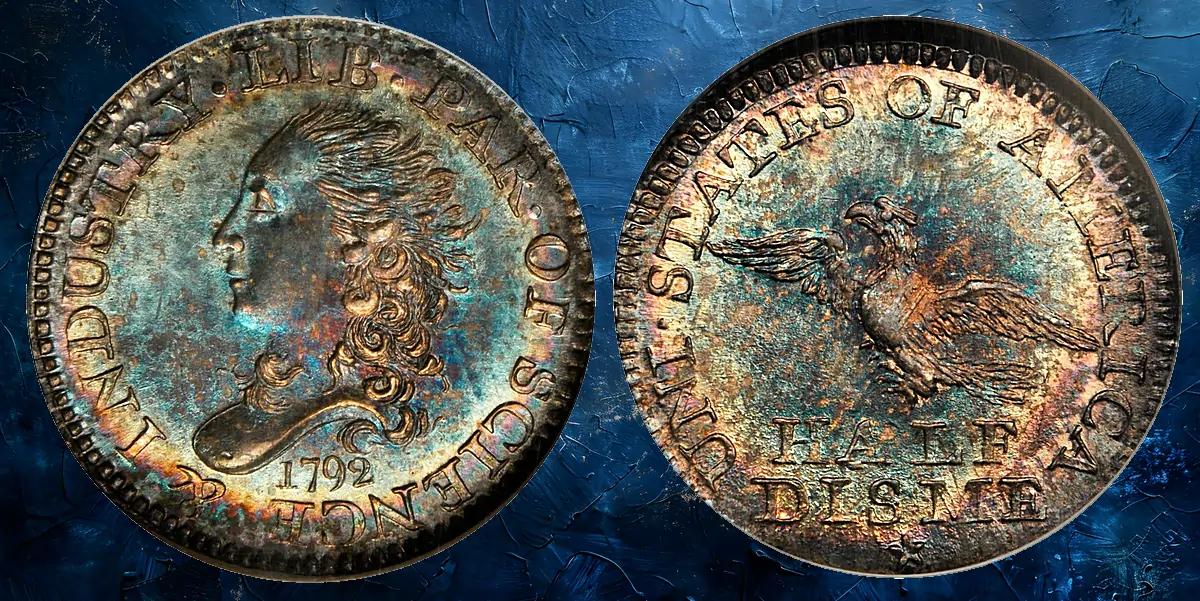
Photo: CoinWeek / Heritage Auctions.
The smallest coins can carry the biggest stories.
Today’s lead is a 1792 Half Disme tied to the earliest documented commercial use of U.S. constitutional coinage. It is also at the center of a pedigree question involving David Rittenhouse.
We also have the new 2026 Proof Set, a Bronze Age hoard from Scotland, practical counterfeit coin detection, a quick guide to ANA grading standards, and a Wednesday check for coin PVC damage.
America’s first federal silver coin returns
On July 13, 1792, Thomas Jefferson recorded paying 30 cents to servants at an inn in Chester, Pennsylvania. Earlier that day, he had collected 1,500 newly struck silver half dismes.
Six of those tiny coins may have changed hands in that payment.
Researchers consider the transaction the earliest documented commercial use of coins struck under the authority of the U.S. Constitution. Jefferson continued making small payments in five-cent multiples as he traveled through Pennsylvania, Delaware, Maryland and Virginia.
The timing was remarkable. Congress had passed the Mint Act on April 2, 1792, creating the U.S. Mint and a decimal coinage system. George Washington commissioned David Rittenhouse as the first Mint Director on April 14.
The Mint did not yet have a finished building. Early work apparently took place at sawmaker John Harper’s Philadelphia premises near Sixth and Cherry Streets. Henry Voigt worked in an acting role before Washington formally named him Chief Coiner in January 1793.
On July 9, Rittenhouse asked Washington for authority to strike cents, half cents, dismes and half dismes. Washington approved. Jefferson delivered $75 to the Mint on July 11 and recorded receiving 1,500 half dismes on July 13.
The arithmetic matched exactly. Each coin was worth five cents.
The two-day turnaround still puzzles researchers. Melting, refining, rolling, cutting planchets, annealing and striking 1,500 coins would have been a remarkable production effort. Numismatist Eric P. Newman suggested the silver may already have been converted into ready planchets before Jefferson delivered it.
No surviving document settles the question.
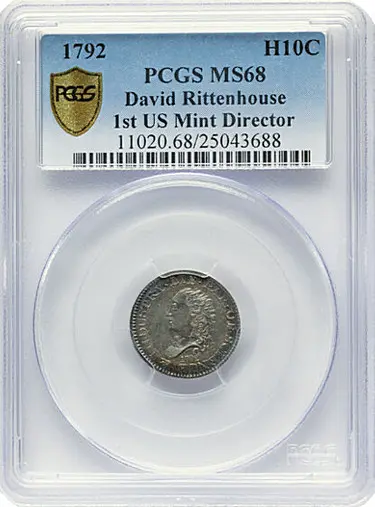
The 1792 Half Disme in its PCGS MS-68 holder. Photo: CoinWeek / Heritage Auctions.
The coin weighs about 1.35 grams, measures about 17.5 millimeters and is approximately 89.2% silver and 10.8% copper. It has a diagonally reeded edge and medal-turn die alignment.
Heritage Auctions is offering the PCGS MS-68 example as Lot 3414 in its October 8, 2026, GACC U.S. Coins Signature Auction. It comes from the Ronald Firman Collection, and Heritage calls it the sole-finest certified example.
The famous Rittenhouse pedigree, however, is no longer certain.
Henry Chapman sold an Uncirculated 1792 Half Disme in 1919 and said it was one of four pieces Rittenhouse had kept. Later researchers connected that coin to a George L. Tilden example sold by Thomas Elder in 1921.
Heritage compared the 1921 catalog photograph with the present MS-68 coin. The firm concluded that the coins do not match. Heritage has removed the Tilden provenance from the secure pedigree and says no proof establishes the present coin as Chapman’s 1919 specimen.
That does not rule out the connection. It simply separates a possibility from a proven fact.
Heritage reviewed 48 confirmed About Uncirculated and Mint State half dismes. Seven share at least some of Chapman’s described characteristics, ranging from this MS-68 to an NGC MS-62. None provides a conclusive match.
The coin’s secure modern history begins in October 1988, when Stack’s offered it as “Property of a New England Museum.” It later passed through Jay Parrino, the Knoxville Collection, Steve Contursi and the Cardinal Collection.
Stack’s Bowers sold it for $1,145,625 in January 2013. Classic Coin Company sold it privately for $1,985,000 in May 2018.
The old stories about Washington supplying the silver, Martha Washington’s table service or Martha posing as Liberty are also unsupported by reliable contemporary evidence. Jefferson’s account book is much closer to the event and carries greater historical weight.
The 2026 Proof Set is out
The U.S. Mint released the 2026 Semiquincentennial Proof Set on October 6 at noon Eastern. It costs $107.
The set contains 10 Proof coins struck at San Francisco, all bearing the S mintmark. They are housed in two protective lenses with a presentation package and certificate of authenticity.
The product limit is 480,000 sets. The Mint lists no mintage limit for the individual coins, so the coins should not be described as having a 480,000 mintage.
The set includes:
- The Emerging Liberty dime
- The Enduring Liberty half dollar
- Five Semiquincentennial quarters
- A Native American $1 honoring Polly Cooper and the Oneida Indian Nation
- The 1776~2026 Jefferson nickel
- The collector-only Lincoln cent
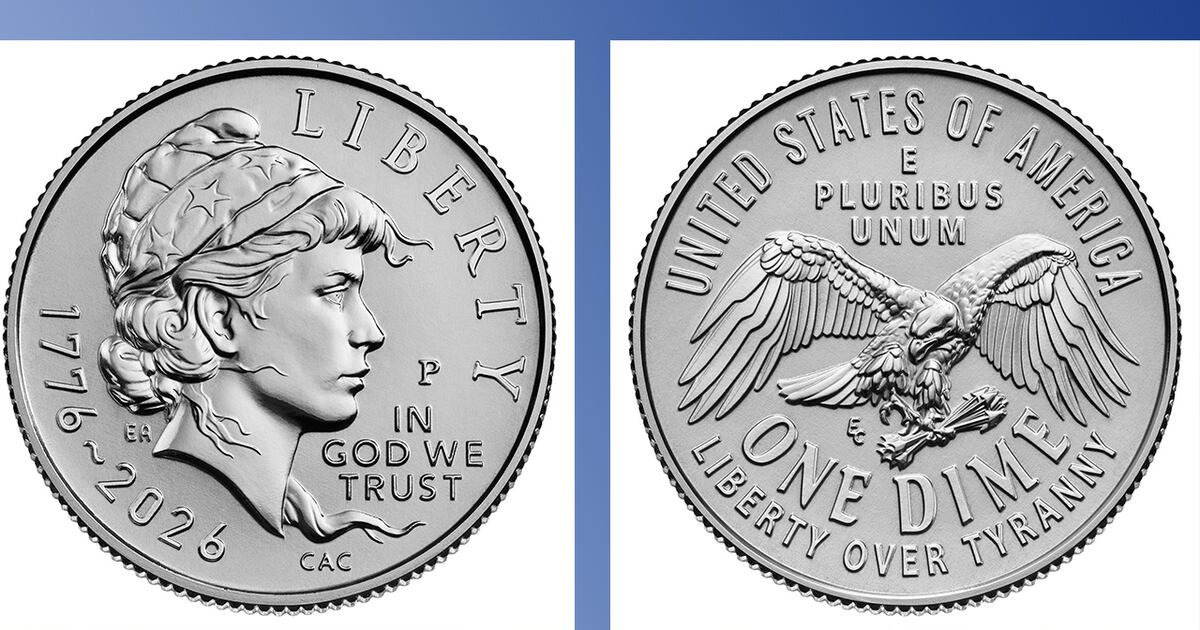
Official U.S. Mint image, via The Coin Show media library.
The Emerging Liberty dime returns Liberty to the denomination for the first time since 1945.
The Enduring Liberty half dollar replaces Kennedy and the Presidential Coat of Arms for 2026.
The quarters honor the Mayflower Compact, the Revolutionary War, the Declaration of Independence, the U.S. Constitution and the Gettysburg Address.
The Mint struck its final one-cent coin for general circulation in November 2025, but it still makes cents for collectors. Victor David Brenner’s Lincoln portrait and the Union Shield reverse remain.
A Proof coin is made with specially prepared blanks and polished dies. It receives at least two strikes. Frosted design elements contrast with mirrored fields.
Design changes have always given collectors something to discuss. This set is a good example of how a new release can become part of the hobby’s history.
More than $70 million in one auction series
Stack’s Bowers Galleries’ Summer 2026 Global Showcase Auction realized more than $70 million, a record for the firm.
The series included the ANA-week sales and the Mack C. Chase Collection of Walking Liberty half dollars. Its 253 lots realized $2,448,125, led by a 1921-D that sold for $183,000.
Big totals attract attention. Still, the volume of mid-priced lots is what keeps an auction series healthy.
If you are building a set on a budget, the auction calendar is still worth watching.
A Bronze Age hoard that explains another one
Two years after the Peebles Hoard was acquired for the nation, another discovery just seven miles away is shedding light on it.
The Blyth Hoard was found in the Scottish Borders in 2022 by metal detectorist Mariusz Stępień. It includes Bronze Age clay moulds that may have been used to make some of the bronze fittings found in the Peebles Hoard.
It also contains two bronze axe-heads and a complete copper ingot. The ingot is the first of its kind found in Scotland. Analysis may help identify the geographic source of metals used in both hoards.
The objects date to the Late Bronze Age, roughly 1150 to 800 BC. Archaeologists found an ancient stone cairn during excavation. The hoard was allocated to National Museums Scotland and moved to the National Museums Collection Centre in Edinburgh for conservation and research.
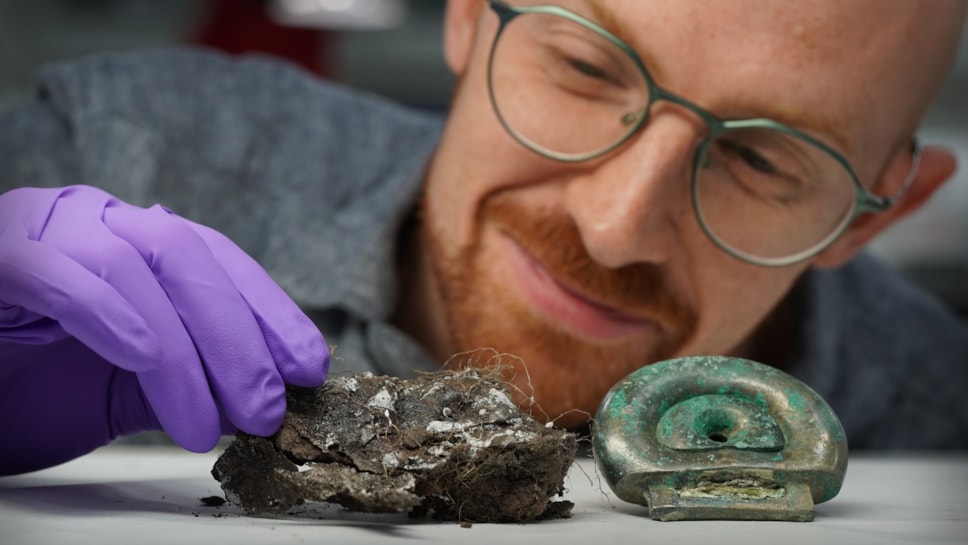
Photo: Stewart Attwood, via National Museums Scotland.
The lesson applies to numismatics, too. Report finds, record their context and let specialists excavate them.
Conservation of the Peebles material also revealed an unexpectedly silver hue. Researchers attribute it to high tin on the surface, likely created through a deliberate enrichment technique.
Counterfeit coin detection: a short checklist
Before buying an expensive coin, slow down.
- Weigh and measure it against official specifications.
- Inspect the edge for seams, filing, tool marks or weak reeding.
- Look for grainy or porous surfaces that may suggest casting.
- Tilt the coin under good light. Watch for unnatural luster or missing flow lines.
- Look up the certification number on the ANACS, NGC, PCGS or CACG website.
- Treat any QR code printed on a holder as unverified.
Authentication is not grading. A genuine coin can grade low. A counterfeit should never carry a legitimate certification.
The rarer the coin, the better the fake may be. Electrotypes of early copper, altered key dates and counterfeit bullion coins all appear in the marketplace.
The Anti-Counterfeiting Educational Foundation continues pushing for uniform standards. Beth Deisher has returned to the ACEF board. Asking sellers about authentication practices is reasonable before you spend serious money.
ANA grading standards in plain groups
The ANA grading standards divide coins into broad condition groups:
- MS-60 to MS-70: Uncirculated, with the number reflecting luster, marks, strike and eye appeal.
- AU-50 to AU-58: Light wear on the highest points.
- EF-40 to EF-45: Light overall wear with strong detail.
- VF-20 to VF-35: Moderate wear with major details clear.
- F-12 to F-15: Noticeable wear with the main design and lettering visible.
- VG, G and AG: Progressively heavier wear.
Grade is only part of value. Strike, color, luster, eye appeal, cleaning and originality matter as well. Read the ANA’s official grading standards.
The Wednesday no-PVC check
Soft flips can contain polyvinyl chloride. As PVC breaks down, it can leave a sticky green film on a coin. That is coin PVC damage, and it may stain or etch the surface permanently.
For safe coin storage for collectors, use holders clearly marked PVC-free. Mylar, polyethylene, polypropylene and hard acrylic are common inert options.
Keep your collection cool, dry and stable. Handle coins by the edges. Remove any flip that feels tacky, looks cloudy or smells strongly of plastic.
Check cardboard holders and albums for moisture or mildew, too. If you find green film, isolate the coin and get professional advice. Do not clean it yourself.
If you are wondering how to store coin collection items after buying the new Proof Set, leave the Mint packaging intact and keep the full package in a stable place. Add individual coins to separate holders only when you have a good reason.
Our guide to storing your coin collection has more practical advice.
What is a coin show?
What is a coin show? It is a temporary marketplace and classroom.
You can compare coins in person, ask dealers questions, buy supplies and practice grading side by side. You do not have to buy anything from every table.
This week’s listings include:
- Salem, Ohio, October 9–10
- Clearwater, Florida, October 10
- Pittston, Pennsylvania, October 10
- Milton, Florida, October 10–11
- Clifton, New Jersey, October 10
- Timonium, Maryland, October 11
- Oberhaching, Germany, October 23–25
- Las Vegas, October 29–31
- Greenville, South Carolina, October 29–31
- Portland, Oregon, October 30–November 1
Bring a want list, loupe and budget. These are reliable coin collecting tips. Ask before handling a dealer’s coins. Take notes, compare prices and do not feel obligated to buy the first example you see.
Confirm hours, admission and venue details with organizers before traveling. Check Find Coin Shows and CoinShows.us.
Standing Liberty quarter 1916 reminder
The 1916 Standing Liberty quarter is the key date and the first year of issue for the series.
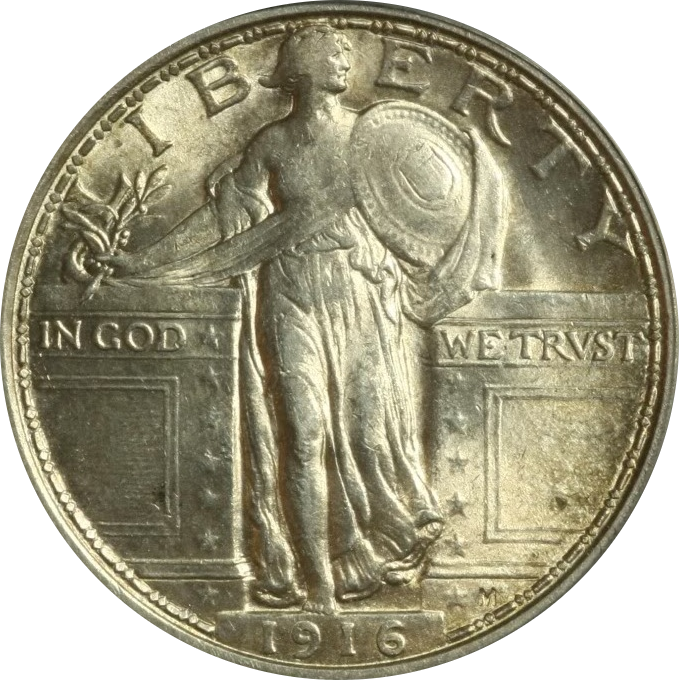
Photo: The Coin Show media library.
A worked-over 1917 Type 1 quarter can be presented as a 1916. Study the date and the design around it closely. When real money is involved, a certified example is usually the safer choice.
That is where good counterfeit coin detection habits matter most.
Sources
- CoinWeek: The Finest 1792 Half Disme Is Back And Its Rittenhouse Pedigree Is No Longer Certain
- Heritage Auctions, Lot 3414
- CoinNews: U.S. Mint Launches Proof Set With Exclusive 1776-2026 Clad Coins
- World Numismatic News: 2026 Proof Set, the Semiquincentennial Edition
- Greysheet: Stack’s Bowers Galleries’ Summer 2026 Global Showcase Auction Realizes Over $70 Million
- National Museums Scotland: “Extraordinary” Bronze Age Find in the Scottish Borders
- ANA Official Grading Standards
- NGC Counterfeit Detection Resources
- The Coin Show: Storing Your Coin Collection
- Find Coin Shows and CoinShows.us
For more coin collecting news and conversation, listen to The Coin Show’s coin collecting podcast and numismatic podcast.