The Daily Mint — Sunday, November 8, 2026: The Kennedy Half Dollars Born When Proof Sets Vanished, A 1921 Peace Dollar Accounting Mystery, and a Sunday No-PVC Check
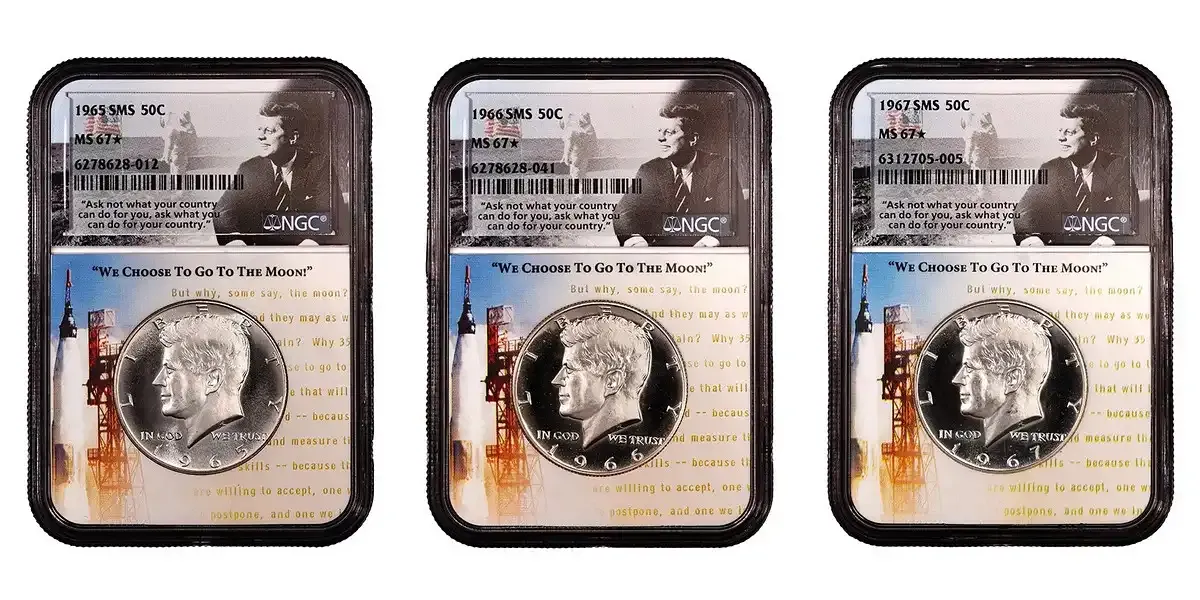
Image: CoinWeek. Three Kennedy half dollars from the 1965-1967 Special Mint Set years, each certified NGC MS-67*.
Welcome to The Daily Mint for Sunday, November 8, 2026. Today’s lead looks at the unusual Kennedy half dollars the Mint made when Proof sets disappeared. We also have a 1921 Peace dollar records mystery and a few useful Sunday checklists.
The Kennedy half dollars the Mint made when Proof sets disappeared
The Kennedy half dollar arrived in public hands on March 24, 1964, just months after Congress authorized the coin on December 30, 1963. Gilroy Roberts designed Kennedy’s portrait, and Frank Gasparro designed the reverse. Many Americans saved the new halves as memorials rather than spending them.
Then the coin shortage brought big changes. The Coinage Act of 1965 eliminated silver from dimes and quarters and reduced Kennedy halves from 90% to 40% silver. Their outer layers were 80% silver, around a core of 21%. The Mint also temporarily removed mintmarks.
With production focused on circulation coins, the Mint suspended annual Proof and Uncirculated sets. Special Mint Sets, or SMS, took their place from 1965 through 1967. Each included a cent, nickel, dime, quarter, and half dollar-91 cents in face value, for $4. The 1964 Proof set had cost $2.10; the Uncirculated set, $2.40.
The San Francisco Assay Office struck SMS coins with specially prepared dies and high-tonnage presses, generally using a single strike. Their surfaces fall between circulation strikes and true Proofs. One curious detail: researcher David W. Lange noted that San Francisco struck the entire 1965-dated SMS production in 1966.
The packaging changed, too. The 1965 set came in a flexible Pliofilm holder with a blue-and-silver token, certificate, and cream envelope. The 1966 and 1967 coins came in rigid plastic holders inside dark-blue boxes.
There are varieties to look for: the 1965 SMS Doubled Die Reverse FS-801; the 1966 SMS Doubled Die Obverse and the famous No FG, missing Gasparro’s initials near the eagle’s right tailfeathers; and the 1967 Quadrupled Die Obverse FS-101. Excessive die polishing caused the No FG. A faint trace of the initials does not qualify.
The Mint produced 2,360,000 sets in 1965, 2,261,583 in 1966, and 1,863,344 in 1967-6,484,927 altogether. That’s why ordinary SMS halves remain affordable. Each is 40% silver, weighs 11.50 grams, measures about 30.6 mm, and contains roughly 0.1479 troy ounce of pure silver.
Recent Heritage results show how much surface quality and variety matter: a 1965 SMS NGC MS-67 Cameo sold for $84 on March 31; a 1965 FS-801 NGC MS-67 brought $341.60 on August 25; a 1966 No FG NGC MS-66 sold for $268.40 on June 23. A 1966 PCGS SP-68 Cameo brought $1,159 on September 22. A 1967 PCGS SP-68 Cameo sold for $268.40 on July 14, while a 1967 NGC MS-68 Ultra Cameo brought $2,562 at the January 17 FUN auction. PCGS CoinFacts records a 1967 SMS Deep Cameo at $31,200 in 2019-an exceptional result, not a typical price.
PCGS uses SP for Specimen; NGC and older holders may use MS. Read the full certification description, not just the number. None of these dates has a mintmark, even though San Francisco made them, so the missing mark is not rare. The hunt is for preservation, Cameo contrast, and varieties. Proof coinage resumed at San Francisco in 1968, when mintmarks returned.
These are useful coin collecting tips for anyone starting a set: compare surfaces closely and learn the varieties before you buy.
Beginner tip: a three-coin 1965-1967 SMS Kennedy date set is an affordable way into an unusual corner of Mint history, and the varieties give you something to hunt for with a loupe.
A 1921 Peace dollar mystery hidden in Treasury records
Researcher Roger W. Burdette found a mismatch in National Archives shipment records. Treasury entries list 1,235,000 first-distribution 1921 Peace dollars, while the Mint reported a mintage of 1,006,473-a gap of 228,527. Excluding 505 coins held for the Annual Assay Commission, locked in Philadelphia’s pyx box until around March 1 or later, makes the gap 229,032.
The new dollar was meant to commemorate peace after World War I and became a hurried symbol of President Harding’s Conference on the Limitation of Armaments, held in Washington from November 12, 1921, through February 6, 1922. Sculptor Anthony de Francisci’s high-relief design created production challenges, but Harding and Mint Director Raymond T. Baker pressed for a 1921 date.
Philadelphia struck the coins only December 28-31, delivering 200,103 on December 29 and 806,370 on December 31. The first 10,000-coin shipment entry is dated December 28; public release followed January 3, 1922. Later schedules added shipments in late December, January, and February.
Burdette considered a transcription error, Morgan dollars mistakenly included in the Peace dollar totals, and coins returned by banks and shipped again. He ruled out transcription error; the Morgan-dollar explanation seems unlikely. Returns and reshipments fit best, but the records show no January or February returns. A cashier’s report records 158,378 returns by April 28, 1922, but that does not prove an earlier reshipment cycle. The numbers still do not reconcile. This is exactly the kind of archival detective story we love digging into on our numismatic podcast.
Beginner tip: 1921 is the key first-year date of the Peace dollar series, and the high relief means many examples show weak strikes; buy well-detailed coins from trusted sellers rather than chasing bargain bin examples.

Image: Roger W. Burdette, via CoinWeek. A 1921 Peace dollar; the high relief meant a normal toggle press often failed to bring up full details.
Quick news notes
- Metals check: Spot gold slipped to roughly $4,070 an ounce Friday after October payrolls beat expectations: 165,000 jobs versus about 65,000 forecast, with unemployment at 4.1%. Rate-hike odds for the December 8-9 Fed meeting firmed. Silver hovered around $51.80-$51.90. October CPI is due Tuesday, November 10. (Kitco)
- CoinWeek Giveaway #666 opened November 7 and runs through November 14. The free-entry prize includes MS-67 SMS Kennedy halves from 1965, 1966, and 1967, plus the fourth edition of Rick Tomaska’s A Guide Book of Franklin & Kennedy Half Dollars. (CoinWeek)
- Royal Canadian Mint: Eight November releases arrived November 3, including designs featuring Lady Peace, Canada’s coat of arms, and Quebec’s Mingan Archipelago National Park Reserve. (Canadian Coin News)
- Auction reminder: GreatCollections’ Sunday top-ten session closes today, November 8. (GreatCollections)
Counterfeit coin detection: a quick checklist
For SMS halves, especially a No FG, start with the seller’s reputation. Verify certification numbers at PCGS or NGC, and read the full description: PCGS calls these SP, while NGC uses MS. Be wary of bargain-priced high-grade coins.
A genuine No FG has no trace of the initials. Faint initials indicate a weak strike, not the variety. Some fakes are ordinary coins with the initials tooled away, so weak or uneven tooling is a warning sign. Check weight and diameter: 40% silver halves weigh 11.50 grams and measure about 30.6 mm. Never clean a suspicious coin; ask a professional for an opinion. For more on counterfeit coin detection, see NGC’s guide.
ANA grading standards, in plain groups
These ana grading standards are a handy way to group grades:
- AG-3 to G-6: Heavy wear, but the outlines remain.
- VG-8 to F-15: Major design details are visible.
- VF-20 to EF-45: Light, even wear; most details stay sharp.
- AU-50 to AU-58: Only a trace of wear on the high points.
- MS-60 to MS-70: Uncirculated, from baggy to flawless.
- Proof: A strike type, not a grade.
Coins with cleaning, damage, or repairs may receive a “Details” grade instead of a number. Read more in our ANA grading standards guide.
Sunday no-PVC check
PVC softeners can leach out over time, leaving sticky green residue and etched surfaces. That’s coin PVC damage, and it can seriously hurt a coin’s value. For coin storage for collectors, choose PVC-free flips or holders made from Mylar, polyethylene, polypropylene, or hard acrylic.
Found green slime? Don’t rub it off; that can drive the damage deeper. Get a professional evaluation. Our full guide on how to store coin collection covers storage options.
What is a coin show? And where to go next weekend
If you’re wondering what is a coin show, think of it as a bourse: dealers buy, sell, and appraise coins and currency, often with a local club hosting the event. Beginners are welcome. Bring a coin and ask for a free opinion.
Here are selected listings for November 14-15. Free entry is noted where listed.
Saturday, November 14
- Cleveland Coin Expo, Broadview Heights, Ohio
- Big Flats Coin Club Coin Show: Big Flats, New York (free entry)
- Charleston Area Coin Show: Cross Lanes, West Virginia (free entry)
- Marion Coin Club Annual Coin Show: Marion, Indiana
- Norfolk Coin Show, Norfolk, Virginia (free entry)
- Tampa Stamp & Coin Expo: Tampa, Florida
- Coins, Cards & Chaos, King of Prussia, Pennsylvania; also Sunday
Sunday, November 15
- BNA Coin & Currency 3rd Sunday Bourse: Cheektowaga, New York (free entry)
- Cromwell-Hartford Coin & Currency Show: Cromwell, Connecticut (free entry)
- Fort Lauderdale Coin Show, Plantation, Florida (free entry)
- Old Bridge Coin, Paper Money & Collectibles Show: Old Bridge, New Jersey (free entry)
- Omaha Monthly Coin & Collectibles Show: Omaha, Nebraska (free entry)
- Phoenix Area Coin Show: El Zaribah Shrine, Phoenix, Arizona
See the CoinShows.us next-30-days listings for details. Confirm hours and venues with the promoter before you travel.
Standing Liberty quarter 1916 reminder
The standing liberty quarter 1916 was the first year of Hermon MacNeil’s design. Philadelphia struck just 52,000, the lowest mintage of the series, making it a key date. Philadelphia used no mintmark then, so none appears on the coin. If you think you’ve found one, don’t clean it; have it authenticated.
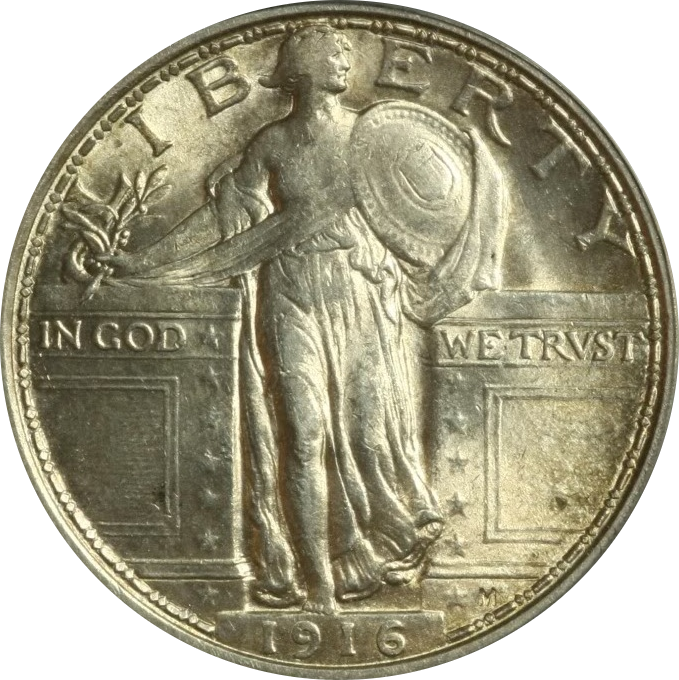
Image: The Coin Show media library. The 1916 Standing Liberty quarter obverse.
The Coin Show podcast is a coin collecting podcast where two friends talk coins in a friendly, casual way. Subscribe and catch every episode on our website, with video episodes on YouTube and audio available through the show’s listening platforms.
Sources
- CoinWeek: Kennedy SMS half dollars
- CoinWeek: Burdette on 1921 Peace dollar Treasury records
- Kitco: November 6 AM report
- CoinWeek contests
- Canadian Coin News: Royal Canadian Mint November releases
- GreatCollections: Sunday top ten
- CoinShows.us: next 30 days
- NGC: counterfeit detection
- The Coin Show: storing your coin collection
- The Coin Show: Official ANA Grading Standards