The Daily Mint — Monday, November 9, 2026: The Gold Coin a Broke Mint Could Barely Afford to Make, The Man Behind Your Favorite Coins, and a Monday No-PVC Check
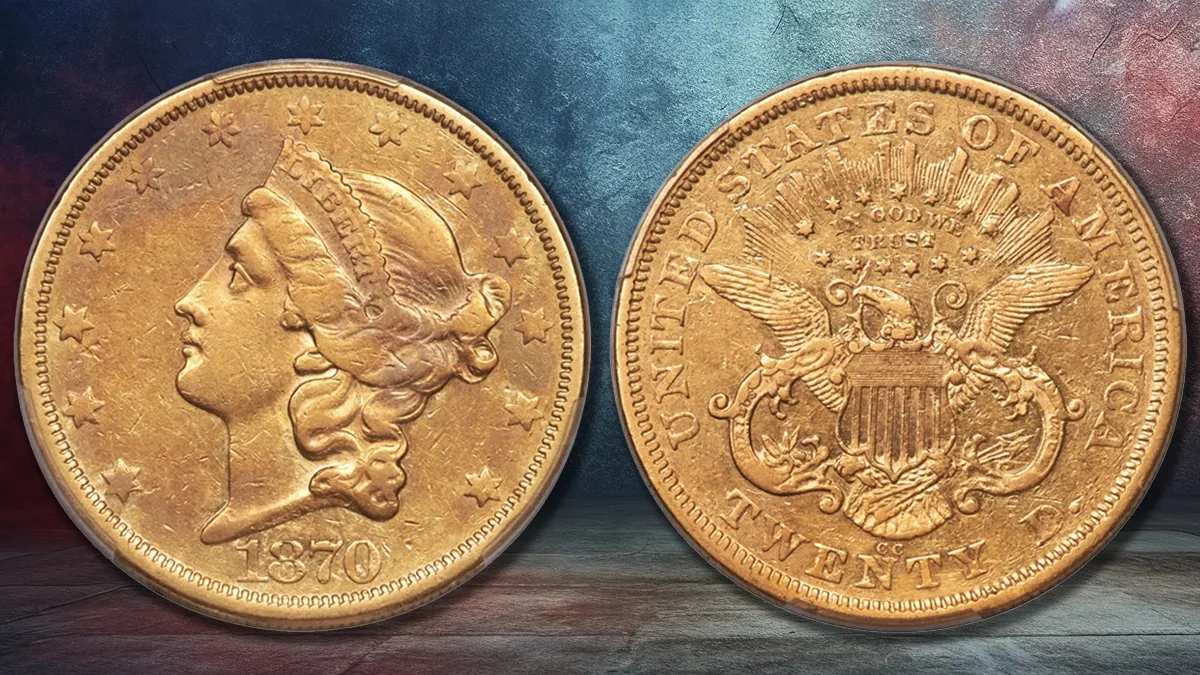
Image: Heritage Auctions, via CoinWeek. The 1870-CC double eagle: no accepted Mint State example is known today.
Welcome to Monday’s Daily Mint. Today: a Carson City rarity born amid a cash shortage, and the sculptor behind the Mercury dime and Walking Liberty half dollar. We also have quick news notes, a Monday no-PVC check, and coin shows to put on your weekend list.
The 1870-CC double eagle: a rarity born from a cash shortage
Carson City needed ready money
The Carson City Mint opened on January 8, 1870, to receive bullion. But opening its doors did not solve a basic problem: the branch lacked a bullion fund to pay depositors promptly. The delays discouraged business during the Mint’s first year. Some miners kept sending their bullion to San Francisco, where payment was quicker.
Congress had authorized the branch in 1863. Abe Curry championed Carson City, supervised construction, and became the Mint’s first superintendent. The 1870 annual report described how slow payments and small batches made the work harder, with extra remelting and reassaying.
The first delivery of double eagles came on March 10. Rusty Goe’s figures record 3,789 coins delivered over five months: 1,332 in March, 398 in April, 1,137 in May, 462 in June, and 460 in August. The Mint’s report provides a cross-check: 3,329 double eagles, worth $66,580, through June 30.
That was Carson City’s smallest annual double eagle output. Today, the 1870-CC is considered the rarest circulation issue of the Type 2 Liberty Head double eagle, struck from 1866 to 1876.
Few survivors, and no Mint State example
PCGS CoinFacts lists 41 examples. Goe estimates 55 to 65 survivors across all grades. There is no complete verified census, and certification records can count the same coin more than once when it is resubmitted or crosses between grading services.
No accepted Mint State example is known. Two die marriages are recognized: Winter 1-A and Winter 2-B. The more frequently encountered 1-A has a higher date and a CC mintmark farther right than the 2-B. On May 4, 1870, Curry asked Mint Director James Pollock for two additional obverse dies.
Auction results show how much an individual coin’s grade, surfaces, and history can matter. The Prestwick PCGS AU53 set a $1.62 million record at Heritage on November 11, 2021. A Carter-Richards PCGS AU55 brought $1.44 million at Stack’s Bowers in 2024. More recent results include $341,600 for a Reno-Carson City Collection NGC XF40, Winter 1-A, at Heritage’s September 2026 ANA sale, and $408,000 for a Texas Gentleman PCGS XF45 at Stack’s Bowers in November 2025.
The design, and a story worth treating carefully
James Barton Longacre designed both sides. The CC mintmark sits beneath the eagle. The motto IN GOD WE TRUST and the denomination TWENTY D. identify the Type 2 reverse; in 1877, the reverse changed to TWENTY DOLLARS for the Type 3 design.
The coin contains 90% gold and 10% copper, weighs 516 grains (about 33.44 grams), measures 34 millimeters, and has a reeded edge. Its gold content is about 0.9675 troy ounce.
A dramatic lost-gold tale follows the issue: 3,600 deficient double eagles, false-bottom trunks, and Curry’s successor Henry F. Rice. Researchers examined the story, but Roger Burdette regarded Frazer’s account as fiction. The documented theft is different: the finest known example, an NGC AU58, disappeared from a Brink’s shipment sent from PCGS on October 17, 2011. Heritage’s archive still shows a $100,000 reward for its safe return. Jeff Garrett and Ron Guth ranked the coin number 75 in the fifth edition of 100 Greatest U.S. Coins (2019).
Beginner tip: An attractive Extremely Fine coin can be a major collection prize when no Mint State example is known. Grade matters, but so do strike, surfaces, appearance, and provenance.

Image: Heritage Auctions, via CoinWeek. The finest known 1870-CC double eagle, NGC AU58, stolen from a Brink's shipment in 2011; the reward notice is still live.
Adolph Weinman: wings, eagles, and the coins we know
Adolph Weinman is best known for two 1916 designs: the Winged Liberty, or Mercury, dime and the Walking Liberty half dollar. But wings and eagles appeared throughout his work as a medalist, figurative sculptor, and architectural sculptor.
In a 1916 letter to The Numismatist, Weinman explained the dime’s wings: “The wings crowning her cap are intended to symbolize liberty of thought.” Research suggests the design drew on two French medals by Oscar Roty.
An earlier eagle offers a link to the Walking Liberty half. Weinman’s 1907 American Institute of Architects medal shows a standing eagle tugging at a laurel branch. That eagle was a direct forebear of the half dollar’s reverse. In 2017, the U.S. Mint brought the designs together on its first palladium bullion coin, a one-ounce $25 piece with the Winged Liberty obverse and AIA medal eagle reverse.
Weinman also created Descending Night for the 1915 Panama-Pacific International Exposition, and designed the 78mm J. Sanford Saltus Award Medal for the American Numismatic Society in 1919, with a rearing Pegasus on the reverse. He made 22 granite eagles for New York’s Pennsylvania Station. Eighteen survive, including two flanking the entrance at 2 Penn Plaza.
Weinman apprenticed with Saint-Gaudens and saw himself first as an architectural sculptor. His son recalled that he objected loudly to being called a medalist.

Image: PCGS CoinFacts, via Numismatic News. Weinman's eagle on the reverse of a 1916 Walking Liberty half dollar.
Beginner tip: Weinman’s two 1916 designs are friendly classic series to explore. Circulated Mercury dimes and Walking Liberty halves are widely available at a range of budgets.
Quick news notes
- Metals check: At about 8 a.m. Eastern, gold was around $4,122 an ounce and silver near $52.58. Prices were rebounding amid safe-haven demand and a softer dollar, with investors watching U.S. inflation data this week. Kitco and CNBC-TV18
- Whitman Baltimore Expo: November 12–14 at the Baltimore Convention Center, with free admission. An 1885 Trade Dollar, one of five known, will be on view. Robert L. Rodriguez signs The Continental Dollar on November 12. CoinWeek
- CoinClinic: Numismatic News’ November 8 feature on bringing out worn dates discusses dateless coins, restored dates, and grading-service policies. Worth a read before paying for a “rare date” that may have been tooled. Read the article
- Auction watch: Heritage’s Starlust auction of the 1893 Columbiana collection closes today, November 9. Auction news
Counterfeit coin detection: a quick checklist
Rare gold like the 1870-CC is heavily counterfeited. These basic checks can help, but they are not a substitute for expert authentication.
- Buy the seller first. Check their reputation and return policy.
- Verify certification numbers at PCGS or NGC, and read the full description.
- Be wary of a bargain-priced, high-grade coin in a six-figure series.
- Check the specifications: a double eagle weighs about 33.44 grams and measures 34 millimeters. Weight and size alone do not prove authenticity.
- Compare the CC mintmark position and die-marriage details with reliable references.
- Altered dates and mintmarks are classic tricks. A tooled date is a red flag.
- Never clean a coin. Cleaning damages surface integrity and can hurt value.
- If you are unsure, get a professional opinion before buying.
See NGC’s counterfeit detection guide.
ANA grading standards, in plain groups
The ANA grading scale runs from 1 to 70. Here’s a simple way to think about the main circulated and uncirculated ranges:
- AG-3 to G-6: Heavily worn, with the date and major features visible.
- VG-8 to F-15: Moderate wear; more design detail remains.
- VF-20 to EF-45: Light to moderate wear, with most details sharp.
- AU-50 to AU-58: A trace of wear on the high points, with most luster intact.
- MS-60 to MS-70: Uncirculated, with no wear; MS-60 may be baggy, while MS-70 is flawless.
Proof describes a method of manufacture, not a grade. Coins with damage or alteration may receive a “Details” grade, which matters for cleaned or tooled coins.
The finest known 1870-CC is AU58, just short of Mint State. That gap is a good reminder of how scarce high grades can be on old rarities. For more, see our ANA grading standards guide.
Monday no-PVC check
Vinyl flips can contain PVC. Over time, plasticizers may leach out, leaving green residue and corrosion on a coin’s surface. That is classic coin PVC damage.
For coin storage for collectors, safer choices include Mylar (polyester), polyethylene, polypropylene sleeves, and hard inert acrylic holders. If you spot green residue, do not rub it off; ask a professional to evaluate the coin.
If your collection still touches vinyl flips, swap them this week. Our guide explains how to store coin collection safely.
What is a coin show? And where to go next weekend
What is a coin show? It’s a bourse where dealers buy, sell, and appraise coins. You can bring coins for opinions, browse dealer tables, and learn from displays.
Confirm hours and venues before you travel.
Saturday, November 14
- Cleveland Coin Expo, Broadview Heights, OH, at Woodside Event Center at St. Michael’s
- Big Flats Coin Club Coin Show, Big Flats, NY (free entry)
- Charleston Area Coin Show, Cross Lanes, WV (free entry)
- Marion Coin Club Annual Coin Show, Marion, IN
- Norfolk Coin Show, Norfolk, VA (free entry)
- Tampa Stamp & Coin Expo, Tampa, FL
- Coins, Cards & Chaos, King of Prussia, PA (also Sunday)
Sunday, November 15
- BNA Coin & Currency 3rd Sunday Bourse, Cheektowaga, NY (free entry)
- Cromwell-Hartford Coin & Currency Show, Cromwell, CT (free entry)
- Fort Lauderdale Coin Show, Plantation, FL (free entry)
- Old Bridge Coin, Paper Money & Collectibles Show, Old Bridge, NJ (free entry)
- Omaha Monthly Coin & Collectibles Show, Omaha, NE (free entry)
- Phoenix Area Coin Show, El Zaribah Shrine, Phoenix, AZ
Check the coin show listings before making plans.
Standing Liberty Quarter 1916 reminder
The 1916 Standing Liberty quarter introduced Hermon MacNeil’s design. Struck only in Philadelphia, it had a mintage of 52,000, the lowest in the series and a true key date. Philadelphia coins do not have a mintmark, so no mintmark is normal. Think you found one in a jar or bulk lot? Don’t clean it; have it evaluated. A genuine example is a five-figure coin in nearly any grade.
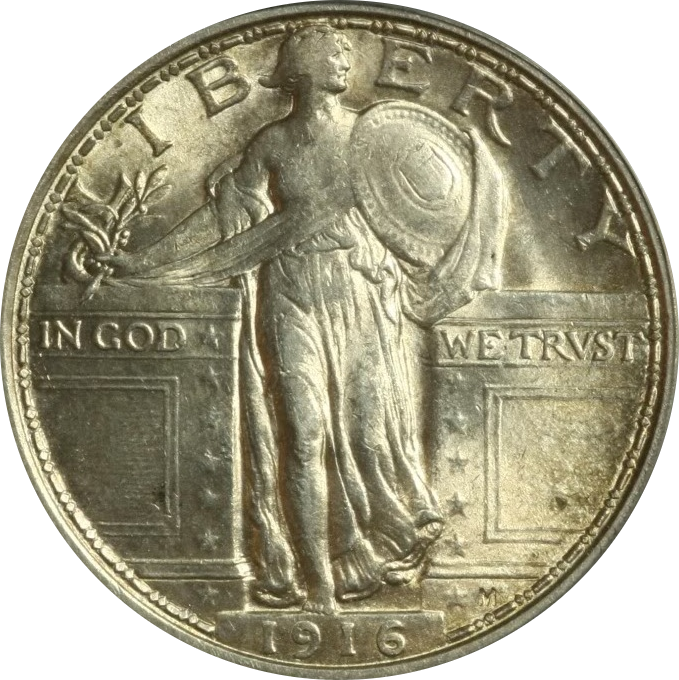
The 1916 Standing Liberty quarter, the lowest-mintage issue in the series.
The Coin Show is a coin collecting podcast and numismatic podcast covering stories like these each week, with coin collecting tips for new and experienced collectors. Browse the blog, listen to the show, or visit our bookstore and merchandise links to keep exploring the hobby.
Sources
- CoinWeek: 1870-CC double eagle
- Numismatic News: Of Wings and Eagles
- CoinWeek: Whitman Baltimore Expo
- Numismatic News: CoinClinic, Bringing Out Worn Dates
- Coin show listings
- NGC counterfeit detection
- The Coin Show: Storing Your Coin Collection
- The Coin Show: Official ANA Grading Standards