Why Did a 1792 Half Disme Just Sell for $2.93 Million? Inside the New Record
It’s small enough to disappear in your pocket. But on October 8, a 1792 half disme sold for $2,928,000 at Heritage Auctions.
The coin, graded PCGS MS68 and offered from the Ronald Firman Collection, is the only example graded that high by PCGS. It more than doubled the previous auction record of $1.41 million, set in 2013. At the same sale, a circulated example graded VG10 brought $85,400.
So what makes this tiny silver coin such a big deal? The answer brings together the beginnings of U.S. coinage, a remarkable story about its first users, and a famous provenance that historians are now taking a fresh look at.
A “small beginning” for American coinage
The half disme, pronounced like “deem”, was worth five cents. It was struck in 1792, the year Congress passed the law establishing the United States Mint. The Mint’s permanent Philadelphia building wasn’t ready yet, so the first coins were reportedly struck at the workshop of sawmaker John Harper.
The half disme stands out as an early federal silver issue intended for use as money, not just a design experiment. Thomas Jefferson’s records help explain why. In July 1792, he noted delivering $75 in silver to the Mint and receiving 1,500 half dismes a couple of days later. At five cents apiece, the total matched exactly.
Jefferson appears to have put the coins to work. Researchers have connected them with small payments he recorded on his travels. President George Washington later referred to a “small beginning in the coinage of half dismes” in an address to Congress.
That phrase fits. The coin is modest in size, but it marks a moment when the new government’s plans for national money became something people could actually spend.
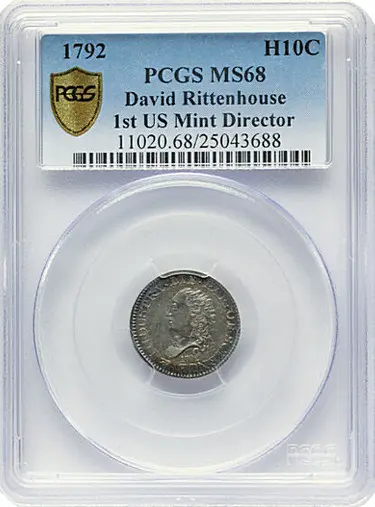
The PCGS MS68 example sold for $2.928 million at Heritage Auctions. Image: CoinWeek / Heritage Auctions.
What’s on the coin, and what isn’t
The half disme’s design has its own character. Liberty faces left on the front, with the date below. The unusual legend reads “LIB. PAR. OF SCIENCE & INDUSTRY,” an abbreviation of “Liberty, Parent of Science and Industry.” On the reverse, a small eagle appears above “HALF DISME,” with “UNI. STATES OF AMERICA” around the border.
One detail worth clearing up: “LIB. PARVA. CIENTIA. VERITAS.” is not the coin’s motto or edge inscription. That wording is sometimes repeated, but the actual legend is on the obverse and reads “LIB. PAR. OF SCIENCE & INDUSTRY.” The coin’s edge is diagonally reeded.
The coin is sometimes wrapped in another familiar story: that Washington supplied the silver, perhaps from the family’s silverware, and that Martha Washington modeled as Liberty. Those stories have circulated for generations, but they are not backed by the best contemporary evidence. Jefferson’s own account points instead to his $75 deposit. Historians continue to examine the early records and the Washington connection, but it’s safer to treat those popular details as unproven.
For a beginner, the design is a handy reminder that the hobby often means checking the story behind a coin as carefully as the coin itself.
A record-setting coin with an open question
For years, the MS68 half disme was associated with David Rittenhouse, the first director of the U.S. Mint. The traditional story traces the coin through Rittenhouse’s family and into a 1919 auction. It’s a compelling link: Rittenhouse was at the center of the Mint’s earliest work, and some high-grade half dismes may have been kept as souvenirs.
But a compelling story and a proven pedigree aren’t the same thing.
Recent research has cast doubt on whether this specific MS68 coin is the one described in the 1919 sale. The catalog description didn’t include a photograph, making a match difficult. Researchers have also compared a later photograph of a coin connected to the story and found it doesn’t match the MS68. Heritage’s current cataloging treats the Rittenhouse connection as unproven rather than established fact.
That doesn’t diminish what the coin is. It does make the research more interesting. As the American Numismatic Association’s overview and this history from numismatic researchers explain, half disme history has been revised as researchers have examined new records and the coins themselves.
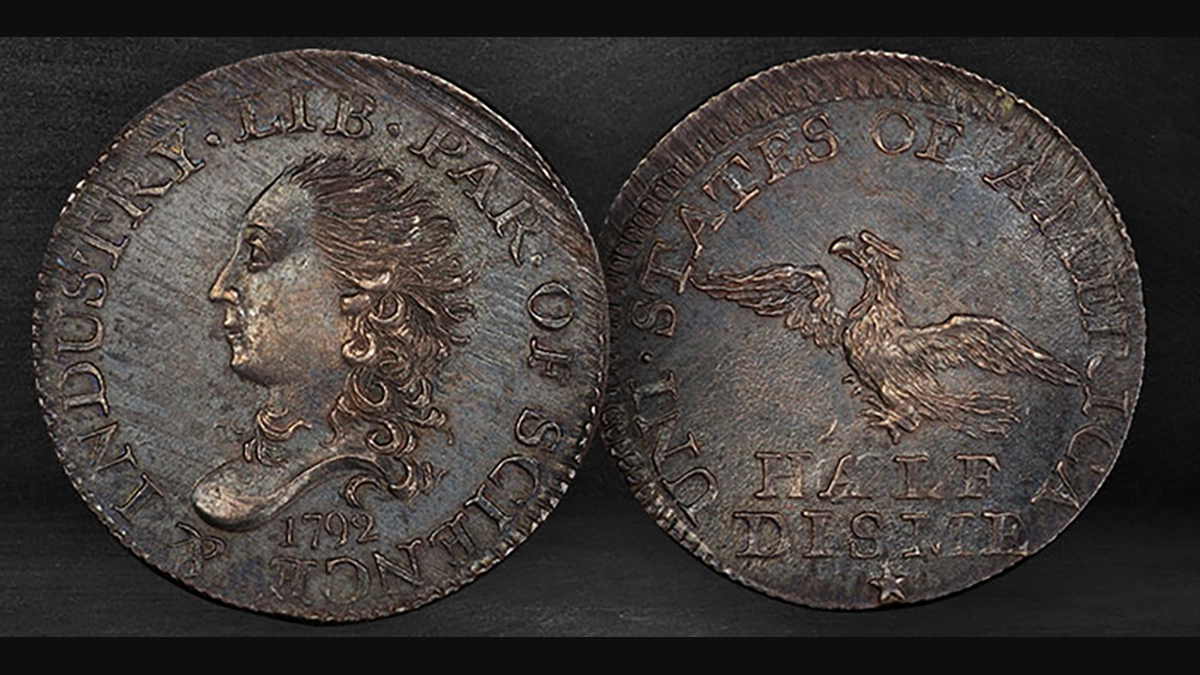
The half disme’s small scale and distinctive design are easier to appreciate up close. Image: GreatCollections / CoinWeek.
Why $2.93 million?
There isn’t one simple answer. The record reflects several strengths coming together:
- Historical importance: The coin belongs to the earliest chapter of federal U.S. coinage.
- Exceptional condition: MS68 is the highest PCGS grade for this issue, and this is the sole example at that level.
- Scarcity at the top: Many surviving half dismes saw circulation. Coins preserved in Mint State are a small and closely watched group.
- A story collectors can follow: Jefferson’s account, the early Mint, and the uncertain Rittenhouse link all give collectors something to investigate.
- Competitive bidding: The coin drew 66 bids at Heritage’s sale, according to the auction report.
The price is a headline about this particular coin, not a promise that every old half disme, or every rare coin, will rise in value. Condition, rarity, history, and buyer interest can combine very differently from one coin to the next.
The $85,400 result for the VG10 example at the same sale offers useful context. It has the same date and design, but its circulated grade and individual appeal differ from the one-of-a-kind PCGS MS68. Both results show strong interest in the issue; they don’t mean the two coins should be compared as if grade were the only difference.
You can see the record coin’s Heritage Auctions lot listing and the VG10 example’s listing.
From auction headlines to the show floor
A multimillion-dollar auction result can make a coin most people have never seen suddenly feel approachable. You don’t need to bid on a 1792 half disme to enjoy the story. At a coin show, you can ask dealers and fellow collectors about early American coins, compare designs, and learn how condition changes what you’re seeing.
That’s part of what makes shows so valuable: they turn a headline into a conversation. And if you’re just getting started, you don’t have to begin with an early rarity. Start with a coin that catches your eye, ask questions, and enjoy the hunt.
We talk about coins, collecting, and stories like this on The Coin Show podcast. Then take the curiosity to a local coin show: you never know which small coin might start a very big conversation.