The Daily Mint — Wednesday, November 4, 2026: The Tiny Mintmark That Made a $25,875 Dime, Two Numismatic Leaders Honored, and a Wednesday No-PVC Check
Image: GreatCollections / via CoinWeek.
Today’s edition leads with a dime whose whole story lives in one tiny letter, plus ANA honors for two collectors who helped shape the hobby. We’ll also check this week’s coin news and share a few useful collecting reminders.
A Forgotten Philippine Mintmark Made a $25,875 Dime
In March 2019, two 1945-S Micro S Mercury dimes sold three days apart. Both were PCGS MS68 Full Bands with CAC approval. One brought $25,850 at Legend Rare Coin Auctions on March 21. The other sold for $25,875 at GreatCollections on March 24, just $25 more. The GreatCollections coin was Item 669971, PCGS certificate 36776596.
The Micro S story reaches back to 1907. That year, the San Francisco Mint used a small S punch on coins struck for the Philippine Islands, then under American administration after the Spanish-American War. Research by David W. Lange dates the punch to 1907. It appeared on Philippine coinage through 1919.
In 1945, the old punch appeared on American Mercury dimes. At the time, mintmarks were hand-punched into individual working dies, so an old tool could find its way back into use. There is no verified record explaining why workers chose it.
Collector Bernard J. Maier identified the variety in 1947, just two years after the coins entered circulation. Today, the Cherrypickers’ Guide lists it as FS-512.

Image: CoinWeek. Left: the regular 1945-S mintmark. Right: the Micro S from the Philippine punch.
The regular 1945-S mintmark is larger and rounder. The Micro S is smaller and more compact, with sharper, more angular serifs. It is a different punch, not a repunched mintmark or doubled die. PCGS’s January 2025 Micro S study shows the details.
Beginner tip: a small mintmark alone is not proof. Compare the whole letter shape against authenticated examples before you call it a Micro S.
The variety appeared in the final year of the Mercury dime. The Roosevelt dime debuted January 30, 1946, on what would have been Franklin D. Roosevelt’s 64th birthday. San Francisco struck 41,920,000 dimes in 1945, but the Mint never recorded how many had the Micro S. PCGS estimates about 30,000 survive. Circulated examples can sell for under $25.
Condition and strike make a major difference. Full Bands means the central bands on the reverse fasces are fully separated. PCGS estimates only about 10 to 12 percent of surviving Micro S dimes have Full Bands. A certified Mint State coin without the designation can bring a few hundred dollars; a top Full Bands example can reach five figures.
The 2026 market shows that spread. On September 8, a PCGS MS66 without Full Bands sold for $195 at Heritage, while a PCGS MS66 Full Bands brought $1,586. On September 9, an MS65 without Full Bands sold for $89 at Stack’s Bowers. A PCGS MS67 Full Bands brought $2,196 on March 28.
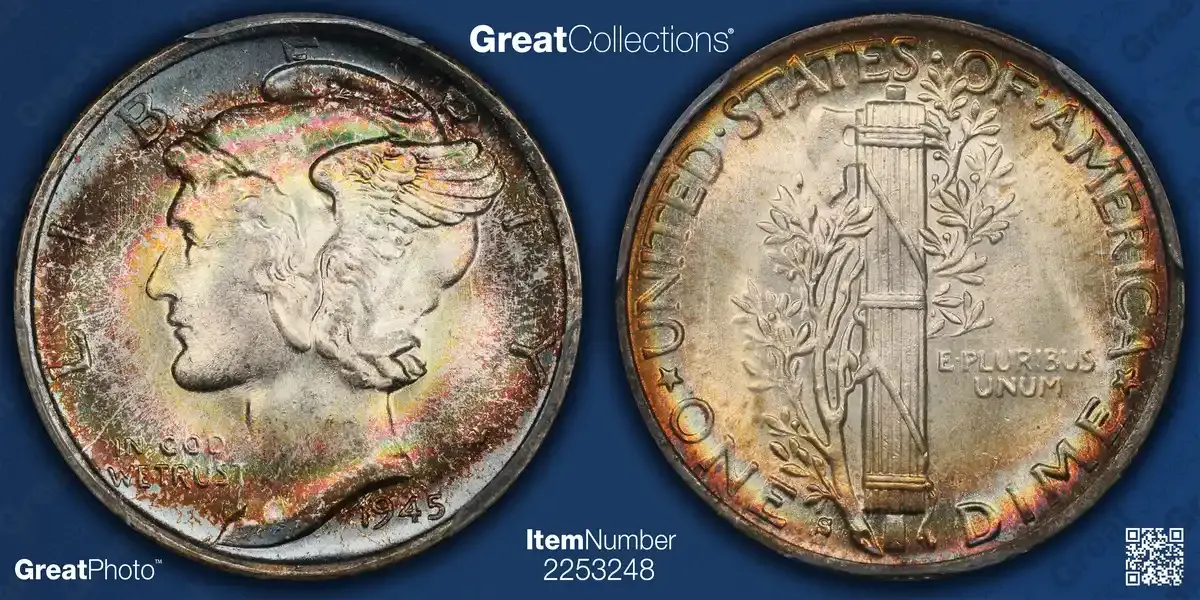
The most recent appearance noted here was October 11, when GreatCollections sold a toned PCGS MS68 Full Bands coin, certificate 25652458, Item 2253248, for $15,255 after 21 bids.

Image: GreatCollections / via CoinWeek.
Since 1945-S dimes are common, this is a genuine pocket-change and coin-roll-hunting variety. Check the mintmark on every 1945-S dime you find. For more variety-hunting talk and practical coin collecting tips, visit The Coin Show.
Two Collectors Who Gave the Hobby Back
The American Numismatic Association presented its 2026 Philanthropy Award to Jim Halperin and Andrew Shiva, among the awardees at the 2026 World’s Fair of Money in Pittsburgh. Their paths were different, but both have put resources into the hobby’s future.

Image: CoinWeek. Jim Halperin.
Halperin entered the coin business at 16 and later co-founded Heritage Auctions. He helped advance grading standards, pricing transparency, and online auction resources. Through the Halperin Foundation, established with his wife, Gayle, he supports the arts, healthcare, and education. He has also said he intends to direct much of his wealth, including his Heritage interests, to charitable causes.

Image: CoinWeek. Andrew Shiva.
Shiva’s collecting spark was a 1917 $2 United States Note he found at a Paris flea market in 1989. By 1995, he had turned his attention to National Bank notes. He founded the National Currency Foundation in 2011, which supports the Hickman Project census of surviving notes. A research associate with the Smithsonian’s National Numismatic Collection, Shiva also helped fund archival rehousing for more than 80,000 international banknotes with his wife, Anya. His family supports the ANA through the Susan Isabel Foundation, named for his mother.
One built the marketplace; the other helped preserve its history. Both have invested in the people, research, and institutions that keep numismatics going.
Quick news notes
- Gold reclaimed $4,000, trading near $4,038–$4,047 an ounce, while silver rose to roughly $51.79–$52.01 as the dollar weakened after U.S. midterm results. FXStreet
- The Whitman Baltimore Coin & Collectibles Expo runs November 12–14 at the Baltimore Convention Center, with free public admission. Stack’s Bowers lot viewing, November 10–13, includes one of five known 1885 Trade Dollars, graded PCGS Proof-63+ CAC, and a 1794 Flowing Hair dollar graded NGC MS-62+. CoinWeek
- The U.S. Mint’s $250 Historical SemiQ gold proof, another America’s 250th anniversary release, goes on sale November 5. Numismatic News
Counterfeit coin detection: a quick checklist
Checking a mintmark variety is counterfeit coin detection in miniature: look closely, compare carefully, and verify before you buy.
- Use a 5x to 10x loupe for mintmark details.
- Compare the coin with authenticated photos, not your memory. PCGS’s 2025 Micro S study is a free reference.
- Know what a variety is, and is not. The Micro S uses a different punch; it is not a repunched or doubled mintmark. Counterfeits of claimed varieties exist.
- Weigh and measure a coin when its metal content or dimensions matter.
- Check certification numbers at PCGS or NGC.
- Ask for a recognized reference or catalog number. Here, that’s FS-512.
- Buy the seller before you buy the coin. Reputation and return policies matter.
For more guidance, see NGC’s counterfeit detection resources.
ANA grading standards, in plain groups
These quick groupings can help you make sense of ANA grading standards. The exact grade still depends on the coin’s design and condition.
- AG-3 to G-6: Heavy wear. The date and main outlines remain visible.
- VG-8 to F-15: Major design details are clear, though wear is obvious.
- VF-20 to EF-45: Details are strong, with wear still visible on high points.
- AU-50 to AU-58: Nearly Mint State, with light friction on the highest points.
- MS-60 to MS-70: No wear from circulation. The range runs from as-made condition to flawless.
- Proof: A special strike type, not a grade by itself.
Coins with problems such as cleaning, damage, or corrosion may receive a Details grade instead of a numeric grade. A Details coin can still have historical importance. And even two coins with the same numeric grade can sell for very different amounts.
For more, visit the ANA grading standards page.
Wednesday no-PVC check
Never store coins in vinyl flips or folders made with PVC. Coin PVC damage can show up as green, slimy residue that etches the surface. Rubbing won’t reverse the damage.
For coin storage for collectors, use holders made from Mylar, polyethylene, polypropylene, or hard acrylic. If you spot green residue, don’t scrub it. Ask a professional to evaluate the coin. Our guide explains how to store coin collection.
What is a coin show? And where to go next weekend
A coin show is a bourse floor where dealers buy, sell, and trade. Many shows also offer club tables, grading submissions, and beginner-friendly help.
Here are selected listings for Saturday, November 7, and Sunday, November 8:
Saturday, November 7: Brandon Coin Club 2026 Fall Show, Brandon, FL (St. Andrew’s Methodist Church), free; Calumet Numismatic Club Show, Crown Point, IN (Lake County Fairgrounds 4-H Building), free; Central Florida Coin Show, Apopka, FL (Apopka Community Center); Lehigh County Coin Expo, Schnecksville, PA (Schnecksville Fire Company); Vienna Coin Show, Vienna, VA (120 Cherry St. SE; 54th year, Saturday and Sunday); Western Maryland Coin Club Show, Ridgeley, WV (Ridgeley Community Center); Knoxville Coin & Currency Show, Knoxville, TN (Rothchild Catering & Conference Center); and ARC Coin Show, Independence, MO.
Sunday, November 8: Milwaukee Numismatic Society Annual Show, Brookfield, WI (Sheraton Milwaukee Brookfield); Greater Atlanta Coin Show, Marietta, GA (IAM Union Hall), free; Clark County Coin Club Semi-Annual Show, Springfield, OH (Courtyard Marriott), free; Detroit Area Coin Show, Southfield, MI (New Hope Banquet Hall), free; Burlington Coin Show, Burlington Township, NJ (Masonic Lodge No. 32), free; Auburn Monthly Coin Show, Auburn, MA (Elks Lodge), free; Long Island Coin Show, Hicksville, NY (Broadway Mall); and Windsor Coin Club Show, Windsor, Ontario (Giovanni Caboto Club).
Check the CoinShows.us weekend listings to confirm hours and venues before you travel.
Standing Liberty Quarter 1916 reminder
The standing liberty quarter 1916 was struck only in Philadelphia. Its mintage was 52,000, the lowest in the series, and it has no mintmark because Philadelphia did not use one that year. It is the series key date. The design was replaced by the Washington quarter in 1932. Never clean one.
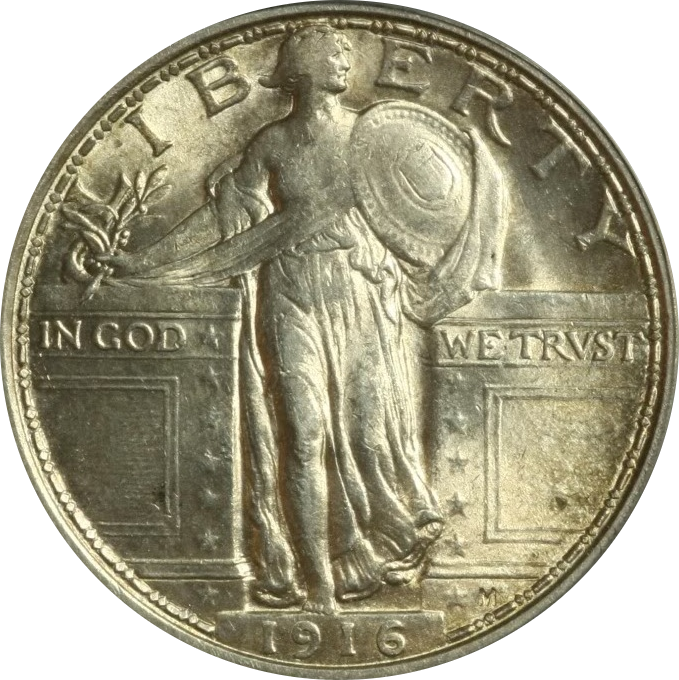
Obverse photo of the 1916 date.
If you enjoy coin stories like this, listen to The Coin Show, a coin collecting podcast and numismatic podcast for collectors at every level, with coin collecting tips in every episode.
Sources
- CoinWeek: 1945-S Micro S Mercury dime
- CoinWeek: ANA honors Jim Halperin and Andrew Shiva
- FXStreet: Gold and silver market update
- CoinWeek: Whitman Baltimore Expo
- Numismatic News: Historical SemiQ gold proof
- CoinShows.us: This weekend
- NGC counterfeit detection resources
- ANA grading standards
- The Coin Show: Storing Your Coin Collection