The Daily Mint — Friday, November 6, 2026: The $20 Gold Coin a Mint Could Barely Afford to Make, a Bank That Jinxed Its Own Money Twice, and a Friday No-PVC Check
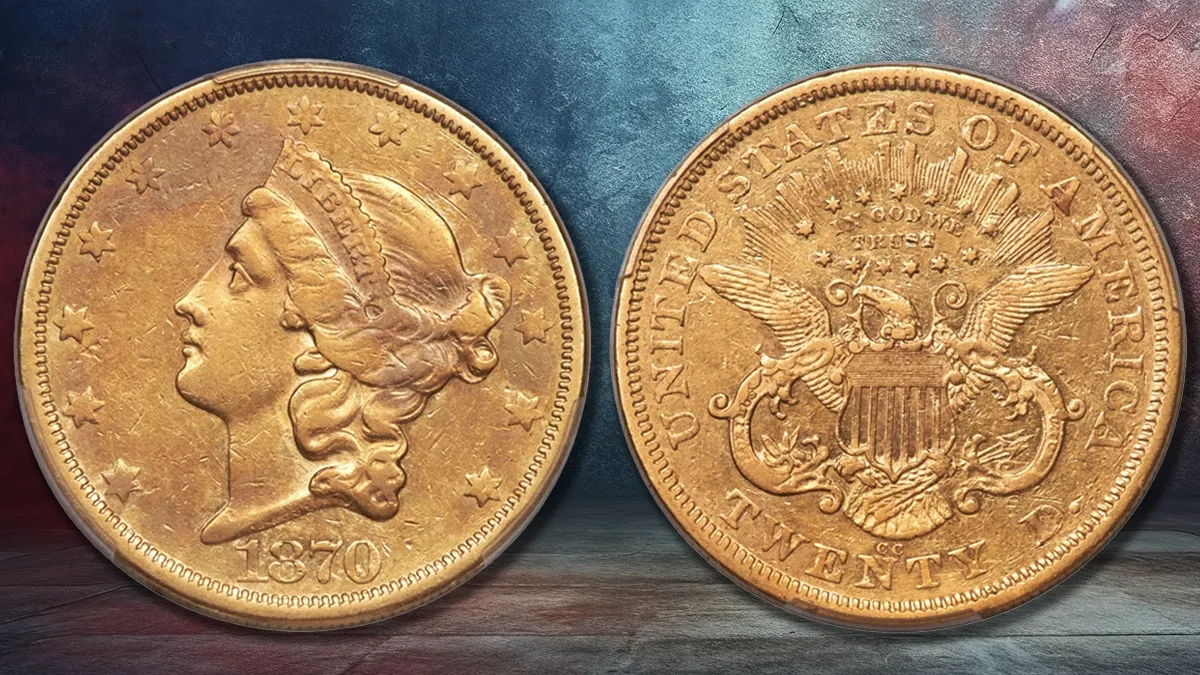
Image: Heritage Auctions / via CoinWeek.
Welcome to the Friday, November 6 edition of The Daily Mint. Today we’re looking at a rare Carson City double eagle born amid a cash shortage, and a Pennsylvania bank whose paper money plates picked up two different errors decades apart. We’ll also make time for a quick Friday check of your coin holders.
The 1870-CC Double Eagle: A Gold Mint That Couldn't Pay Its Own Bills
The Comstock Lode helped make the case for a Nevada mint. Congress authorized the Carson City branch in 1863, and Abraham “Abe” Curry promoted the town, supervised construction, and became the mint’s first superintendent. The Carson City Mint opened on January 8, 1870.
But the new mint had a practical problem: the government supplied no bullion fund. Without ready money to pay depositors, it could not promptly pay miners for their gold and silver. The delays discouraged business, and some miners continued sending bullion to San Francisco, where payment was prompt.

Image: via CoinWeek. The Carson City Mint building.
That difficult start is part of the story behind the 1870-CC double eagle. Carson City struck just 3,789, its smallest annual output of double eagles and the rarest circulation issue of the Type 2 Liberty Head double eagle, made from 1866 through 1876.
The coins were delivered over five months. Rusty Goe’s figures list 1,332 in March, 398 in April, 1,137 in May, 462 in June, and 460 in August. The first delivery of twenties was around March 10. The Mint’s 1870 annual report offers a cross-check: 3,329 double eagles through June 30, worth $66,580.
No accepted Mint State example is known. PCGS CoinFacts lists 41 survivors, while Rusty Goe estimates 55 to 65 in all conditions. These are estimates, not a definitive census.
The auction record belongs to the Prestwick specimen, graded PCGS AU53, which sold at Heritage on November 11, 2021, for $1,620,000. A PCGS AU55 Carter-Richards coin sold for $1,440,000 on November 19, 2024. More recently, a PCGS XF45 brought $408,000 at Stack’s Bowers on November 11, 2025, and an NGC XF40 from the Reno-Carson City Collection sold at Heritage on September 2, 2026, for $341,600.
Beginner tip: a coin's story and its surfaces can move its price more than the number on the holder. The AU55 Carter-Richards coin sold for less than the AU53 Prestwick coin. Grade is a starting point, not a verdict.
There is also a documented theft. An 1870-CC double eagle graded NGC AU58 disappeared from a Brink’s shipment sent from PCGS on October 17, 2011. Heritage’s archive still lists it as “Not Sold” and stolen, with a $100,000 reward for its return. Even that AU58 coin would not fill the Mint State gap.
A separate lost-gold tale tells of 3,600 deficient double eagles, false-bottom trunks, and Superintendent Henry F. Rice. Researcher Roger Burdette regards the tale as fiction. The recorded mintage remains 3,789.
James Barton Longacre designed the coin. Liberty faces left wearing a beaded coronet, reportedly modeled on the Crouching Venus sculpture. The reverse shows an eagle with a shield, with IN GOD WE TRUST in an oval of stars. The small CC mintmark sits below the eagle. In 1877, the reverse changed from TWENTY D. to TWENTY DOLLARS for the Type 3 design. The coin is 90% gold and 10% copper, weighs about 33.44 grams, measures 34 mm, and contains about 0.9675 troy ounce of gold.
For new collectors, the lesson is simple: grade is not the whole story. Surfaces and provenance matter, and even a worn Carson City coin carries real history.

Image: via CoinWeek. The NGC AU58 coin stolen from a Brink's shipment in 2011. A $100,000 reward once stood for its return.
The Bank That Jinxed Its Own Money, Twice
The Annville National Bank of Pennsylvania, charter 2384, had two face plates made with design errors about 20 years apart.
The first was a Series of 1875 10-10-10-20 plate, made when the bank was chartered in 1878. A siderographer accidentally rolled a D instead of an A into the upper-right plate letter on the $20 position. The letters should have read A-B-C-A. Bureau Chief Edward McPherson certified the plate on May 27, 1878. It was the second plate certified under the new process introduced that year.
The bank organized on April 17, 1878, and was chartered a month later. With $50,000 in capital and $45,000 in circulation, it ordered 600 sheets of 10-10-10-20 notes, worth $30,000. The sheets were delivered June 21, with serials 1–600 and numbers B839553–B840152. The mislettered $20 notes went into circulation.
The error was caught and repaired on October 2, 1878. The repairer wrote on the proof: “Check letter D should have been letter A on the $20. Repaired Oct 2d 1878-This plate was made during my shift Oct 2d 1878.”
Twenty years later, a Series of 1882 5-5-5-5 plate had a different problem. Certified on March 2, 1898, it carried Bruce-Roberts signatures, but the correct combination for the April 18 plate date was Lyons-Roberts, current from April 7. The issue was caught just in time. The plate was modified and recertified April 22; no error notes were issued.
The Gold Standard Act of March 14, 1900, required the bank to order a 10-10-10-20 plate again, since only a third of its circulation could be $5 notes. That plate was made correctly. Adam Stroup spotted the errors using the Society of Paper Money Collectors Bank and Bankers Database.

Image: via Numismatic News. The Annville National Bank on Main Street, circa 1910. Courtesy of Mark Hotz.
Beginner tip: provenance and paperwork matter as much in paper money as in coins. The proof sheet with the repairer's handwritten note is part of the story. Keep records of where your finds come from.
Quick news notes
- Gold was around $4,065 an ounce Friday, slipping about 1% intraday but still on track for its best week in over two months. Silver was around $52.33, up about 1%, as traders watched the U.S. jobs report. Read CNBC’s metals update.
- Gettysburg Address quarter rolls and bags go on sale November 13. Read about the quarter.
- The Whitman Baltimore Expo runs November 12–14, with free admission. Stack’s Bowers lot viewing opens November 10, featuring an 1885 Trade Dollar, one of five known, and a 1794 Flowing Hair dollar. Expo details.
- Heritage’s Starlust auction, featuring the 1893 Columbiana collection, closes November 9. Check the auction calendar.
Counterfeit coin detection: a quick checklist
For a major rarity, a documented pedigree and a trusted grade both matter. Keep these basics in mind:
- Buy the seller first: look for dealers with a track record.
- Have major rarities certified by NGC or PCGS, and verify the number at PCGS Cert Verification or NGC Cert Lookup.
- Compare weight and metal. An 1870-CC double eagle is 90% gold and weighs about 33.44 grams.
- Be cautious of bargain listings for rare dates in high grade.
- Study documented die varieties and pedigrees before buying.
For more on counterfeit coin detection, see NGC’s guide.
ANA grading standards, in plain groups
A quick way to read the ANA grading standards is to think in broad groups: About Good (AG-3) to Good (G-6); Very Good (VG-8) to Fine (F-15); Very Fine (VF-20) to Extremely Fine (EF-45); About Uncirculated (AU-50) to AU-58; and Mint State (MS-60) to MS-70. Proof describes a strike type, not a grade.
Details grades are another category: they describe a coin with a problem that affects its grade. And even About Uncirculated examples of great rarities can be prizes. The 1870-CC is a good example, since no Mint State example is known. Learn more about ANA grading standards.
Friday no-PVC check
Coin PVC damage can show up as green residue or a sticky film from polyvinyl chloride flips, especially after exposure to heat and humidity. For coin storage, choose materials such as Mylar, polyethylene, polypropylene, or hard acrylic holders.
If you spot green residue, don’t rub it off. Get a professional evaluation. A useful habit for coin storage for collectors: check one flip or album page every Friday. For more on how to store coin collection, see our storage guide.
What is a coin show? And where to go next weekend
What is a coin show? It’s a gathering where collectors and dealers can view, buy, sell, and discuss coins and other numismatic items. Here are selected listings for Saturday, November 7, and Sunday, November 8. Confirm hours and venue before traveling.
Saturday, November 7: Liberty Coin Club’s Money Show, Anthony (St. Paul area), MN; ARC Coin Show, Independence, MO (American Legion Post #21); Brandon Coin Club 2026 Fall Show, Brandon, FL (St. Andrew’s Methodist Church, free); Calumet Numismatic Club Show, Crown Point, IN (Lake County Fairgrounds 4-H Building, free); Central Florida Coin Show, Apopka, FL (Apopka Community Center); Chillicothe Coin Show, Chillicothe, OH (Ross County Fairgrounds); Knoxville Coin & Currency Show, TN (Rothchild Catering & Conference Center); Lehigh County Coin Expo, Schnecksville, PA (Schnecksville Fire Company); Stark County Coin Club Show, Canton, OH (St. Joseph Catholic Church); Vienna Coin Show, Vienna, VA (120 Cherry St SE, 54th year, Saturday and Sunday); Western Maryland Coin Club Show, Ridgeley, WV (Ridgeley Community Center).
Sunday, November 8: Milwaukee Numismatic Society Annual Show, Brookfield, WI (Sheraton Milwaukee Brookfield); Greater Atlanta Coin Show, Marietta, GA (IAM Union Hall, free); Clark County Coin Club Semi-Annual Show, Springfield, OH (Courtyard Marriott, free); Detroit Area Coin Show, Southfield, MI (New Hope Banquet Hall, free); Burlington Coin Show, Burlington Township, NJ (Masonic Lodge No. 32, free); Auburn Monthly Coin Show, Auburn, MA (Elks Lodge, free); Long Island Coin Show, Hicksville, NY (Broadway Mall); CINA Fall Coin Show, Springfield, IL (Northfield Center); Second Sunday Coin Show, Melbourne, FL (Azan Shriners Center).
See the weekend listings at CoinShows.us.
Standing Liberty Quarter 1916 reminder
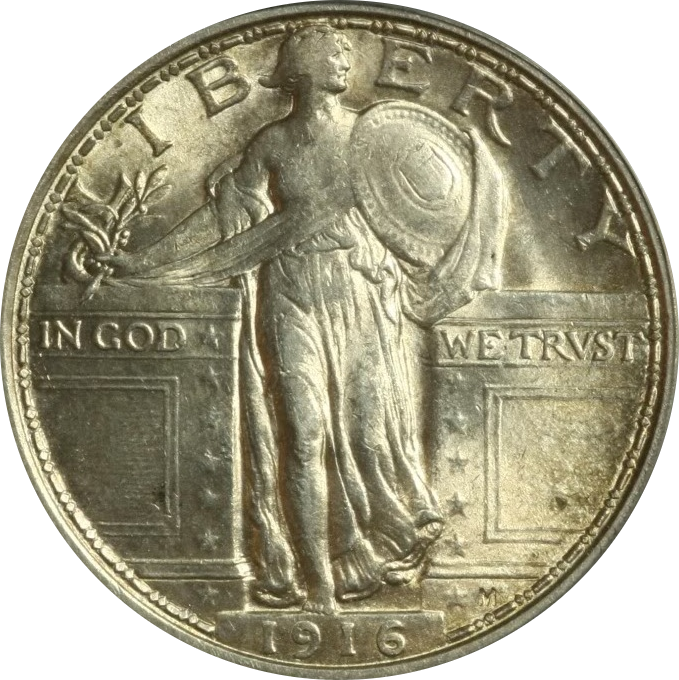
The standing liberty quarter 1916 was the first year of Hermon MacNeil’s design. It was struck only in Philadelphia, which did not use a mintmark. With a mintage of just 52,000, it is the lowest-mintage issue of the series and a key date. If one turns up, don’t clean it.
For more coin collecting tips, join us for The Coin Show, our coin collecting podcast and numismatic podcast. We talk coins, collecting, and the stories behind the hobby.
Sources
- CoinWeek: 1870-CC Double Eagle
- Numismatic News: Annville National Bank face plates
- CNBC: Gold and silver market update
- CoinWeek: Gettysburg Address quarter
- CoinWeek: Whitman Baltimore Expo
- CoinWeek: 2026 auction calendar
- CoinShows.us: This weekend
- NGC: Counterfeit detection
- The Coin Show: Storing your coin collection