
The Daily Mint — Friday, October 23, 2026: A Gold Coin Hidden in a Love Token, Six Hundred Coins Still Sealed Since 1961, and a Friday No-PVC Check
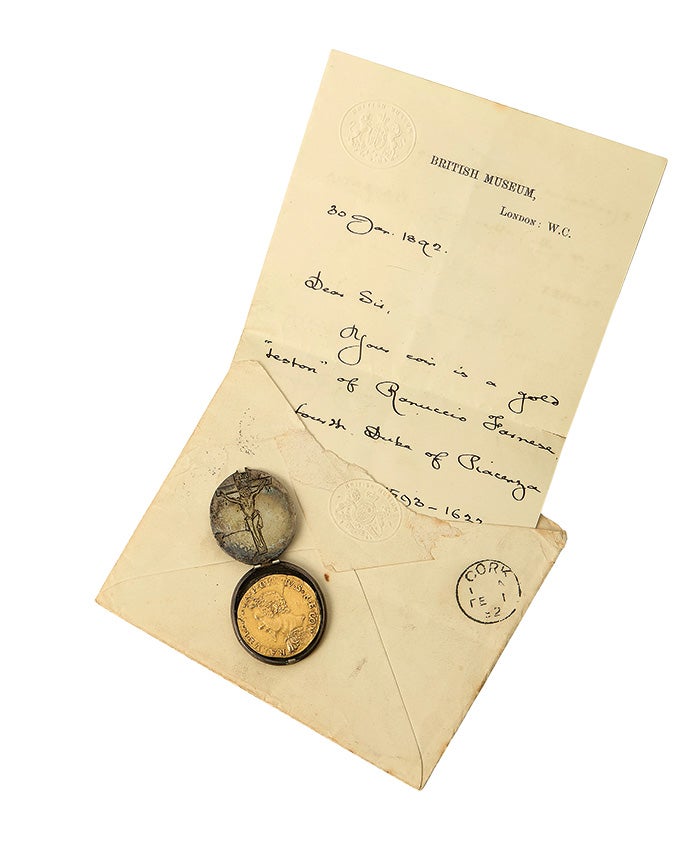
The Coppinger marriage locket with the 1619 gold 2 doppia inside, shown with the 1892 British Museum letter identifying the coin. Image courtesy of Rosebery's Auctions London via Numismatic News.
Today’s stories are about objects that kept coins safe, and the histories those objects preserve. We’ll look at a 17th-century gold coin found inside a marriage locket, six hundred coins still strapped inside a Mint box, and a quick Friday check for PVC in your collection.
A Coin Encased With Love
A marriage keepsake from County Cork
The oval silver locket was likely made in 1660 to mark the marriage of Robert Coppinger and Margarett Coppinger, Catholic landowners in County Cork, Ireland. Its front shows the Nativity. The reverse depicts the Adoration of the Magi and bears the inscription “ROBT COPPINGER & MARGARETT COPPINGER als. ROCHE.”
Inside is a gold 2 doppia struck in 1619 at Parma and Piacenza during the reign of Duke Ranuccio I Farnese. An engraving of the Crucifixion shares the locket’s interior. Roseberys notes that high-value coins were carried as jewelry at the time. The doppia circulated as trade gold and was often held by wealthy Europeans.
It is not known when or why the locket was lost. Around 1850, a farm laborer found it beneath Mashanaglass Castle in County Cork. The laborer took it to the parish rector, who had it restored and gave it to a Coppinger descendant.
“Very few objects survive with such a vivid sense of the people and place to which they belonged,” says Anna Evans, Head of Works of Art at Roseberys.
The locket took the blow
A spade damaged the locket when it was found, but left the coin untouched. Evans said: “The survival of the coin is owed to the locket: sealed inside it, the coin was shielded from the very spade that unearthed it near Mashanaglass around 1850… It is rare to find a coin whose journey from the mint to a marriage keepsake to its rediscovery is so fully documented.”
The coin and locket were sold at Roseberys’ Fine & Decorative auction on Oct. 1, 2026. The lot included a copy of the 1895 Cork Historical and Archaeological Society Journal, which reported the discovery, and a handwritten 1892 letter from the British Museum’s Keeper of Coins identifying the coin. It sold for £8,528, above its £3,000–£5,000 estimate.
Two doppias are rare survivors because they were often melted or reminted. Examples dated 1619 tend to appear at major sales and bring high prices.
There’s a practical lesson here: coins can survive because of what surrounds them. A locket, tin, folded envelope or wooden box may protect a coin better than leaving it loose in a drawer. The story is another reminder that packaging and storage can become part of a coin’s history.
Six Hundred Coins, and the Straps Have Never Been Cut
At the inaugural Welland Coin Show on Oct. 3, longtime collector Jerry Lemick brought an original Royal Canadian Mint wooden box. Inside were 100 Proof-Like sets from 1961: 600 coins in total, still held by the Mint’s original metal straps.
Lemick bought the box from a relative in 1964 and has never opened it. The sets contain roughly 111 troy ounces of pure silver. The question for a future owner is a tough one: preserve the original packaging, or open the box to see the untouched sets inside?
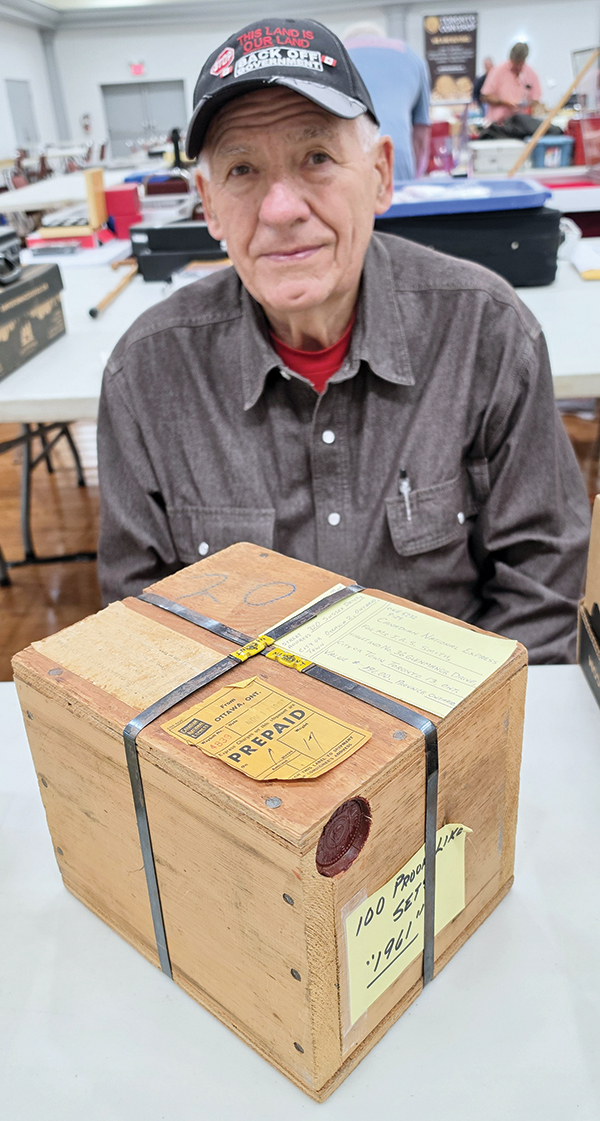
Jerry Lemick with the unopened Royal Canadian Mint wooden box holding one hundred 1961 Proof-Like sets, at the inaugural Welland Coin Show. Photo by Mike Walsh via Canadian Coin News.
The same show featured a very different find. Michael Findlay of Certified Coins of Canada brought examples of Samoa’s new 100-tālā polymer banknote, issued for the 100th anniversary of Queen Elizabeth II’s birth. He acquired them at a September show in the Netherlands. Only 20,000 notes were produced, each with a distinctive QEII serial-number prefix. On Sept. 30, Samoa’s Cabinet ordered a hold on the note’s release and use pending a government review. It remains unknown how many reached collectors first.
Beginner tip: Original packaging can be part of an item’s story. A sealed box, original Mint shipping strap or dated dealer envelope may add provenance. Before opening anything old, photograph it as found and keep the packaging. It can help show that the coins were not cleaned or switched. If you do open a sealed lot, work somewhere clean and dry, over a tray, with clean hands.
Quick news notes
- U.S. 90 percent silver coins are still selling below spot, according to Patrick A. Heller. Early-2026 liquidation overwhelmed refiners; some temporarily accepted only .999 fine material, payments ran 4–6 weeks late, and dealers are still moving 90 percent coins at a discount. Heller notes silver rose 460.1 percent, from a $20.84 COMEX close on Oct. 5, 2023, to $116.73 on Jan. 28, 2026. It has since traded in the $50s and $60s, while industrial demand continues to grow. Read Heller’s report.
- Toronto Coin Expo runs today and tomorrow at the Toronto Reference Library, after Alliance Coin & Banknote and Geoffrey Bell Auctions opened the weekend. Check show details.
- Samoa’s 100-tālā QEII note had only 20,000 made. Cabinet ordered a hold on Sept. 30, and some notes were already in collector hands. Read the Canadian Coin News report.
Counterfeit coin detection: a quick checklist
A coin set in jewelry, a locket or a bezel may be sold as a keepsake, and the mount can hide the edge. For counterfeit coin detection, keep these checks in mind:
- Inspect the edge and rim where the coin meets the mount.
- A genuine 17th-century gold coin will have irregular, hand-hammered edges, not a perfect milled circle.
- Look for soft detail or a seam that may indicate a cast.
- Weigh and measure the coin against published specifications.
- Be cautious of a romantic story without a paper trail. A documented history, like the 1892 British Museum letter in the Coppinger lot, is useful evidence.
ANA grading standards, in plain groups
These six groups offer a simple way to understand the ana grading standards:
- AG-3 to G-6, Good: Heavy wear, but outlines remain readable.
- VG-8 to F-15, Fine: Main details are clear and lettering is sharp.
- VF-20 to EF-45, Very Fine to Extremely Fine: High points still show wear.
- AU-50 to AU-58, About Uncirculated: A trace of wear appears on the highest points.
- MS-60 to MS-70, Mint State: No wear; marks and strike help determine the grade.
- Proof: A strike type, not a grade.
The Coppinger coin is a reminder that old gold and silver can have honest mount damage or a test cut. Such a coin may receive a Details qualifier and still command real money.
Friday no-PVC check
Green residue on a coin may be a sign that PVC has begun to break down from a holder or flip. Over years, that soft plastic can leave deposits and cause coin PVC damage to the surface. That’s why checking holders matters as much as checking coins.
For coin storage for collectors, choose PVC-free materials such as Mylar, polyethylene, polypropylene and hard acrylic. If a coin came to you in an old soft flip or taped holder, check that holder first and move the coin into something inert. Store coins in a cool, dry place and handle them by the edges. Never rub green residue off a coin yourself.
For more on how to store coin collection, see our storage guide.
What is a coin show? And where to go this weekend
If you’re wondering what is a coin show, it’s a gathering where collectors can browse, buy, sell and talk coins with dealers and other hobbyists. Here are some listings for Oct. 23–25, 2026:
- 88th Annual Iowa Numismatic Association Coin Show: Prairie Meadows Racetrack and Casino, Altoona, Iowa; Oct. 23–25; free entry.
- Citrus County Coin, Currency & Collectibles Show: Florida National Guard Armory, Crystal River, Florida; Oct. 23–24; free entry.
- Wasatch Winter / Utah Coin Show: SLCC Miller Conference Center, Sandy, Utah; Oct. 23–24.
- Ocean County Coin Club Annual Show: Laurelton Fire House, Brick, New Jersey; Oct. 24; free entry.
- St. Johns County Fall Coin, Currency & Collectibles Show: St. Johns County Agricultural Center, St. Augustine, Florida; Oct. 24; free entry.
- Ozark Coin Club Show: Glendalough Conference Center, Springfield, Missouri; Oct. 24.
- Tuscarawas County Coin Club: Tuscora Park, New Philadelphia, Ohio; Oct. 24.
- Elgin Coin Club Coin Show: Holiday Inn Elgin, Elgin, Illinois; Oct. 25; free entry.
Hours and venues should be confirmed with the promoter before travel. Find more listings at CoinShows.us.
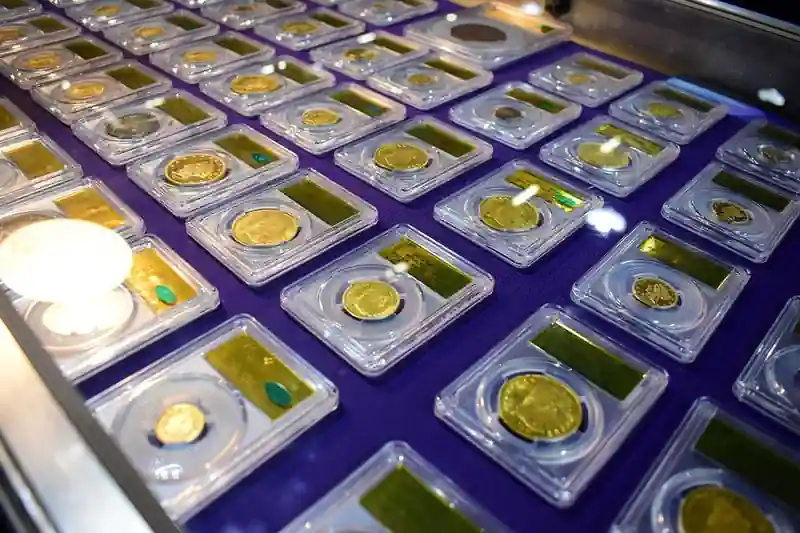
Coin cases on a bourse floor. Image via CoinShows.us.
Standing Liberty Quarter 1916 reminder
The standing liberty quarter 1916 was struck only in Philadelphia, with a mintage of 52,000, the lowest of the series. That makes it the key date collectors watch.
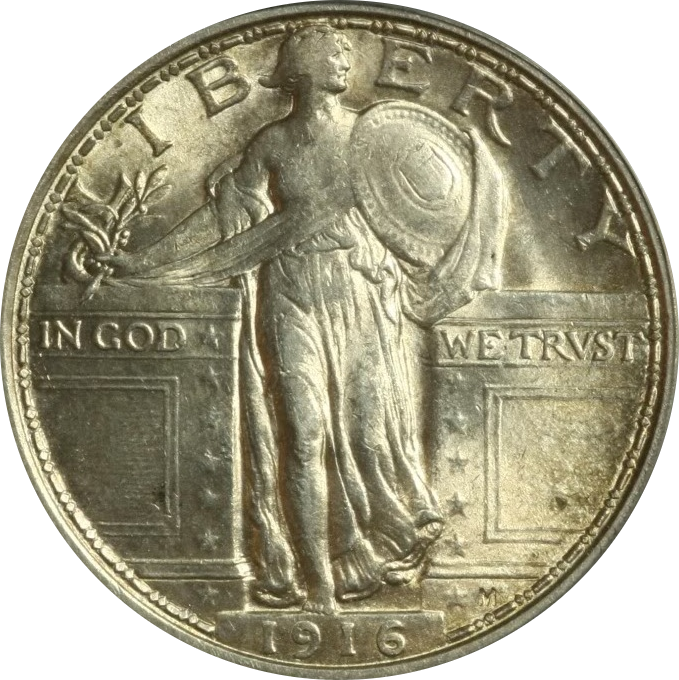
Image from The Coin Show media library.
The Coin Show is a coin collecting podcast and numismatic podcast for collectors at every level. Visit our website and YouTube channel for conversations, video, and coin collecting tips.
Sources
- Numismatic News / World Coin News, “Auction: A Coin Encased with Love”
- Numismatic News, “The Future for U.S. 90 Percent Silver Coins”
- Canadian Coin News, “Two unusual finds at inaugural show”
- CoinShows.us weekend calendar
- NGC, Counterfeit Detection
- American Numismatic Association
- The Coin Show, “Storing Your Coin Collection”