The Daily Mint, Monday, October 12, 2026: Germany’s Biggest Hadrian Hoard, a Saint Olaf Penny Surfaces in Norway, and a Monday No-PVC Check
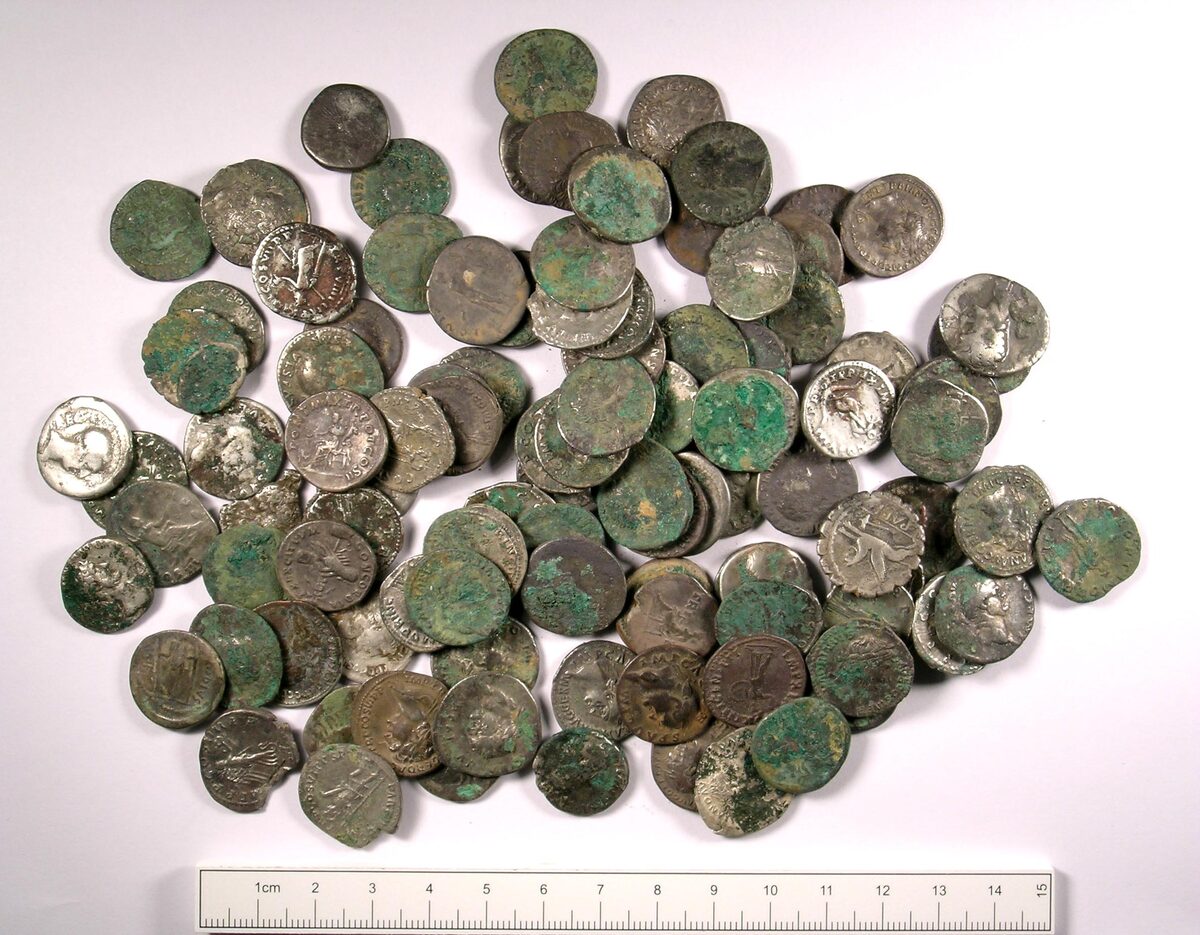
Photo: Sussex Archaeological Society, Portable Antiquities Scheme / The Trustees of the British Museum, CC BY-SA 4.0, via Wikimedia Commons. This is another Roman hoard, shown for comparison with the Wesseling find.
A detectorist’s careful report helped bring a remarkable Roman hoard to light. Plus, a rare Norwegian penny, two Carausius coins at auction, and a quick check to protect your collection.
Germany’s biggest Hadrian-era hoard
Licensed metal detectorist Oliver Riedl was searching a field near Wesseling, south of Cologne, when his detector kept signalling more metal underground. He stopped and contacted archaeological authorities. Their excavation recovered 934 Roman silver denarii, weighing about 6.8 pounds (roughly 3 kilograms).
Authorities say the coins were probably buried intentionally between A.D. 125 and 150. The find is the largest Roman coin hoard from Hadrian’s reign discovered in Germany, and it is now on display at the LVR-LandesMuseum Bonn.
Roman historian Johannes Wienand called the hoard a time capsule of the money people used day to day. A legionary earned roughly 300 denarii a year gross, making the hoard worth about three years of a soldier’s pay. Saving that much could take six, seven or eight years.
The field sat near the Rhine frontier, with Roman Cologne and a legionary fortress at Bonn nearby. That raises the possibility of a military connection, though the owner remains unknown.
There’s a useful lesson in how this discovery unfolded: Riedl had permission, was licensed and reported the find right away. If you uncover something that may be archaeological, stop digging, report it to the proper authorities and don’t clean the coins. Context can matter as much as the objects themselves.
A Saint Olaf penny turns up in Norway
Archaeologist Anne Skogsfjord identified a silver penny of Olaf Haraldsson, better known as Saint Olaf, in Norway’s Mørstad hoard. Fewer than 20 Olaf Haraldsson coins are known to survive. Of this particular type, only four were previously recorded: three in Sweden and one in Norway, found in 1924. The Mørstad example is the first of its kind found in Norway since then, and the Museum of Cultural History calls it a sensation.
Struck around 1024–1028, the penny shows Olaf facing left in a conical helmet. A Golgotha cross appears in front of his portrait. The inscription reads ONLAF R+ NORMANORV, or “Olaf, King of the Norwegians.” The reverse carries a double cross and an inscription meaning “My leader, my lord.”
The coin was modelled on Anglo-Saxon pennies struck under Cnut the Great. Small knife cuts on both sides offer a close-up detail of its working life: people made such cuts to check the silver content during payments. Olaf played a key role in spreading Christianity in Norway, and he may have chosen the design himself.
The Mørstad hoard, found beside the Glomma River at Åmot, has passed 5,000 coins. The Museum of Cultural History’s latest count is 5,500. The Olaf penny is set to go on display in the museum’s new Mørstad Hoard exhibition in Oslo on November 20.
Two rare Carausius coins sell for £16,000
Two silver denarii of Carausius, dated about A.D. 286–293, have sold at auction for £16,000, well above their combined estimate of about £10,000. A detectorist found the coins at Westbury-on-Severn in Gloucestershire in June 2023.
Carausius was a Roman military officer who declared himself emperor in 286 and ruled Britain for nearly a decade in a breakaway state, striking coins of his own. One denarius was graded extremely fine; the other was noted for its exceptional left-facing portrait.
Auctioneer Dominic Chorney described the coins as important pieces of economic, propaganda and social history. Their story is also a reminder to pay attention to provenance: where a coin came from and how it was found can add important context.

Photo: Derby Museums Trust, Portable Antiquities Scheme, CC BY 2.0, via Wikimedia Commons. A Carausius denarius recorded by the Portable Antiquities Scheme, shown for comparison with the two just sold.
Mint and world notes
- The U.S. Mint opens orders for the 2026 American Innovation $1 Coin Reverse Proof Set on Tuesday, October 13, at noon Eastern. The $60 set includes four San Francisco reverse proof dollars for Iowa, Wisconsin, California and Minnesota, plus a certificate of authenticity. Household limit: two.
- The Royal Canadian Mint has released Heraldic Landscape: Animals of Canada, a mint issue, not a circulating coin, and a follow-up to its 2024 Birds of Canada release. Designer Cathy Bursey-Sabourin placed an animal for each of Canada’s 13 provinces and territories around the shield, with heraldic lines suggesting scenery such as the aurora and the Rockies. Options include a 5 kg pure silver coin, limited to 120 at $28,899.95 CAD, and a selectively gold-plated 5 oz coin, limited to 1,400 at $1,029.95 CAD. Shipping is to Canada and the United States only.
- The 1971-S Eisenhower dollar prototype, Judd-2147, closes at GreatCollections on Sunday, October 18, around 6:36 p.m. Pacific. Only three examples are known.
- The 2026-W Enhanced Uncirculated Silver Eagle, with its dual 1776–2026 date and Liberty Bell 250 privy mark, quickly sold out its 125,000 mintage and remains unavailable on the Mint site. Secondary-market prices are now the option for buyers, so set realistic expectations.
Counterfeit coin detection: a Monday checklist
The hoard stories are exciting, but a good deal should stand on more than a good story. Keep these checks in mind when buying:
- Buy the coin, not the tale. Be sceptical of exciting discovery stories without paperwork or provenance.
- Weigh and measure the coin against official specifications.
- Check the edge for seams or weak reeding. Grainy or porous surfaces can suggest casting.
- Treat holder QR codes as unverified. Enter the certification number yourself on the grading company’s website.
- Remember that authentication and grading are different. A holder is a promise, not proof of authenticity.

Photo: Bruxton, public domain, via Wikimedia Commons. A Morgan dollar in an older Paramount holder from the Redfield Collection. Familiar packaging is easy to imitate.
For more, see NGC’s counterfeit detection resources.
ANA grading standards in plain groups
Here’s a quick guide to common grade ranges under the ANA grading standards:
- MS-60 to MS-70: Uncirculated, with no wear from circulation.
- AU-50 to AU-58: Light wear on the highest points.
- EF-40 to EF-45: Light overall wear with strong detail.
- VF-20 to VF-35: Moderate wear, with major details clear.
- F-12 to F-15: Noticeable wear, but the main design and lettering remain visible.
- VG, G and AG: Progressively heavier wear and less detail.
Grade is only one part of value. Rarity, demand, originality, eye appeal and provenance matter, too.
The Monday no-PVC check
Soft plastic flips can contain polyvinyl chloride, or PVC. As it breaks down, it may leave sticky green residue. What collectors call coin PVC damage. That residue can stain or permanently etch a coin’s surface.
For safer coin storage for collectors, choose holders clearly marked PVC-free. Mylar, polyethylene, polypropylene and hard acrylic are common inert materials. Remove any flip that feels tacky, looks cloudy or smells strongly of plastic. Isolate the coin and seek professional advice; don’t clean it yourself.
Keep your collection cool, dry and stable, handle coins by their edges, and check cardboard holders and albums for moisture or mildew. Old album pages are worth a close look, especially if they’ve been stored in a damp basement or attic.

Photo: Billjones94, CC BY-SA 4.0, via Wikimedia Commons. Coins in soft flips in album pages. If the plastic feels tacky, looks cloudy or smells strongly of plastic, that is your cue to check it.
For more on how to store your coin collection, see The Coin Show’s storage guide.
Coin collecting tips: what is a coin show, and what’s on this Monday?
A coin show is a temporary marketplace and classroom where you can compare coins in person, ask dealers questions, buy supplies and practise grading. You don’t have to buy something at every table.
Monday, October 12, is a quiet day for shows, but there are a few ways to join in:
- The Greater Jacksonville Coin Club meets at the Elks Lodge in Jacksonville, Florida, from 6 to 8 p.m.
- The Redmond Coin Club of Central Oregon meets at Redmond VFW Post 4108 from 6 to 8 p.m.
- Gold Standard Auctions’ Monday Coins and Estates Auction starts at 5 p.m. Central.
- Richard Edwards Auctioneering holds a Monday Coin Auction in Greenville, Ohio, at 4 p.m.

Photo: Donald Trung Quoc Don, CC BY-SA 4.0, via Wikimedia Commons.
Confirm hours, admission and venue with the organiser before travelling. Check Find Coin Shows and CoinShows.us for listings. A club meeting can be a low-pressure way to start, and a good place to ask about fake coins and storage before buying anything expensive.
Standing Liberty quarter 1916 note
The Standing Liberty quarter 1916 is both the first year and the key date of the series, making it a target for alterations. A worked-over 1917 Type 1 can be dressed up as a 1916. Look at the date and surrounding fields for tooling, unnatural surfaces or wear that doesn’t match the rest of the coin. For a significant purchase, a certified example from a reputable grading service is usually the safer choice.
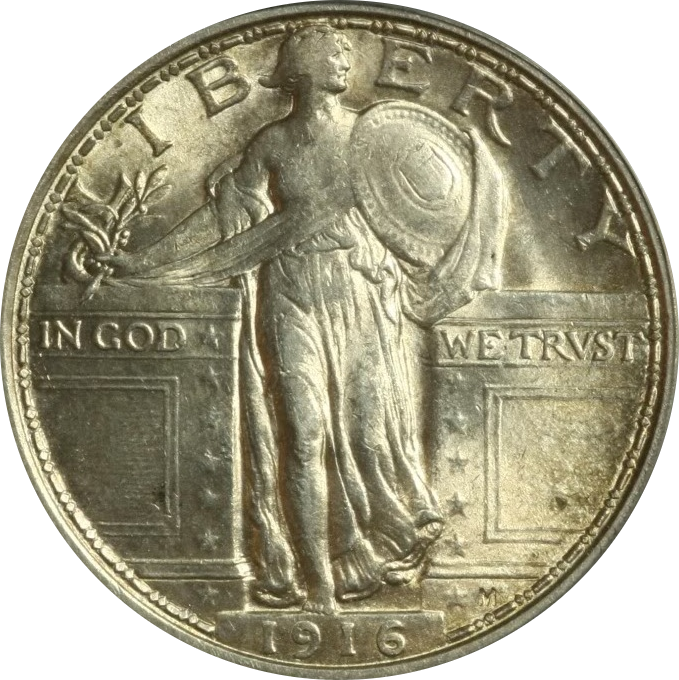
Photo: The Coin Show media library.
Thanks for spending part of your Monday with us. Listen to The Coin Show, our coin collecting podcast and numismatic podcast, and find video episodes on our YouTube channel.
Sources
- Fox News: “Man’s metal detector find leads to massive treasure hidden for centuries”
- The History Blog: “‘National treasure’ coin identified in Mørstad Hoard”
- Museum of Cultural History, University of Oslo: Olaf Haraldsson coin discovery
- BBC News: “‘Extremely rare’ Roman coins found in Forest of Dean up for sale”
- CoinWeek: “The $10 Eisenhower Dollar That Became a $264,000 Rarity Returns to Auction”
- World Numismatic News: “Heraldic Landscape: Animals of Canada Silver Coins 2026”
- 2026 American Innovation $1 Coin Reverse Proof Set release information
- ANA official grading standards
- NGC counterfeit detection resources
- The Coin Show: “Storing Your Coin Collection”
- Find Coin Shows and CoinShows.us
- The Coin Show gallery: 1916 Standing Liberty quarter