The Daily Mint — Sunday, November 1, 2026: Gold From “America’s Titanic,” Barber Dimes on a Budget, and a Sunday No-PVC Check
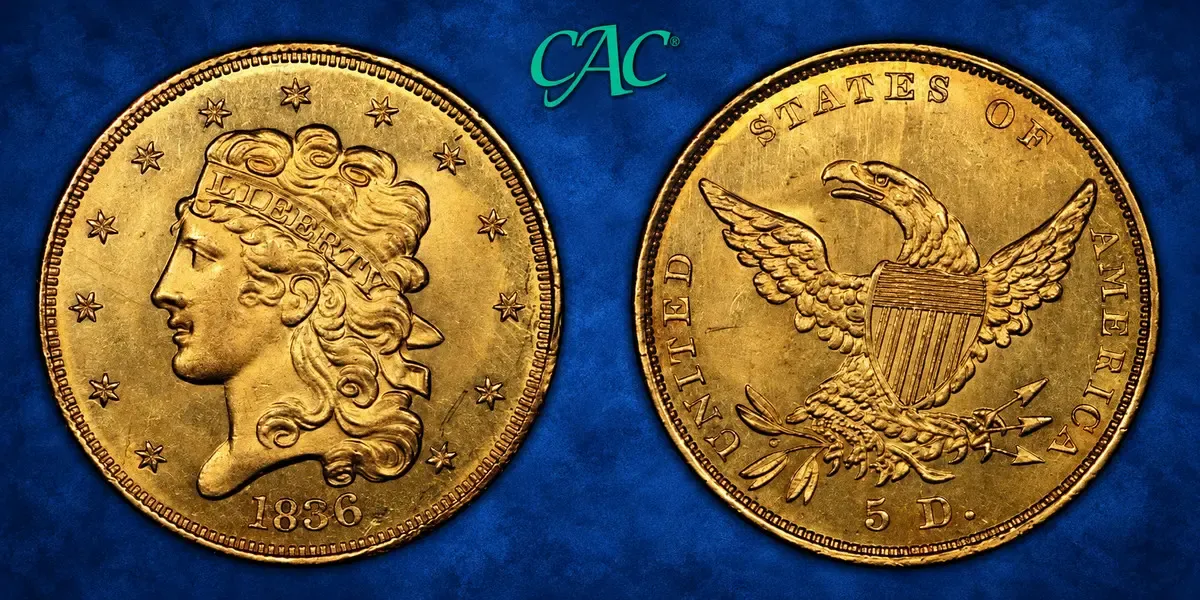
An 1836 Classic Head half eagle graded CAC MS-63 with an S.B. Pulaski shipwreck pedigree. Image: CAC Grading / via CoinWeek.
Welcome to the Sunday edition of The Daily Mint. Today: gold from a steamship disaster, a budget-friendly classic silver series, quick news, and the usual Sunday no-PVC check.
Gold From 'America's Titanic': The 1836 Half Eagle That Went Down With the Pulaski
A disaster at sea, and the money aboard
On the night of June 14, 1838, the steam packet S.B. Pulaski suffered a starboard boiler explosion about 40 miles off the North Carolina coast. The ship was northbound from Savannah toward Baltimore, after leaving Savannah on June 13 and stopping in Charleston. It broke apart and sank in roughly 45 minutes. Only 59 people survived; historical sources generally place the death toll at about 128. Contemporary newspapers called it one of the worst disasters ever to strike the American coast. Much later, Discovery Channel used the title “America’s Titanic” for an Expedition Unknown episode about the wreck.
Built in Baltimore in 1837 by John A. Robb & Co., the Pulaski carried passengers, cargo, and mail for the Savannah and Charleston Steam Packet Company. Its affluent clientele included travelers escaping the Southern summer.
Unlike the S.S. Central America, which sank with commercial bullion in 1857, the Pulaski’s treasure was largely passenger valuables. Contemporary estimates put its face value near $150,000. One survivor, Charles Ridge, reportedly lost $20,000 in gold coins alone. These were coins people carried in pockets, purses, and strongboxes: a snapshot of money in use in the 1830s.
Recovery and the half eagle
Endurance Exploration Group, through the Swordfish Partners venture, began surveying a suspected wreck site in 2017 at roughly 120 feet deep. Blue Water Ventures International later joined. The team announced early U.S. and foreign silver coins in January 2018, then gold. In May, artifacts bearing the Pulaski name, including a candlestick holder marked “SB Pulaski” and a numbered brass tag, confirmed the wreck’s identity. By September, the team reported more than 500 gold and silver coins. The first 502 went to market through a commercial sale.
The finds included U.S. gold half eagles and silver, as well as coins from Spain, Mexico, Great Britain, and elsewhere. Foreign coins still played a major role in American commerce, and several foreign gold issues were legal tender. Numismatic Conservation Services and NGC handled conservation, attribution, and grading, with a special Pulaski label. PCGS-certified Pulaski coins also entered the market.
The coin featured here is an 1836 Classic Head half eagle struck in Philadelphia, where the mintage was 553,147. PCGS lists nine die marriages for the date. In the early 1830s, U.S. gold coins were worth more as bullion than their face value, so coins were exported or melted. Congress responded with the Act of June 28, 1834, lowering the half eagle’s standard weight to 129 grains and pure gold content to 116 grains.
Chief Engraver William Kneass designed the Classic Head: Liberty faces left, with curly hair and a LIBERTY headband, surrounded by 13 stars. The reverse shows an eagle with a shield. The Mint removed E PLURIBUS UNUM from the reverse to help distinguish the lighter coinage. The design ran from 1834 through 1838, before Christian Gobrecht’s Liberty Head replaced it in 1839.
The coin contains 89.92% gold, weighs 8.36 g, has about 0.24169 troy oz of fine gold, measures 22.5 mm, and has a reeded edge. Since the wreck came only about two years after mintage, some Pulaski gold surfaced in remarkable Mint State condition. NGC highlighted an 1836 $5 graded MS63+. In January 2025, Heritage sold an 1836 HM-2 half eagle graded NGC MS64 with CAC approval and the S.B. Pulaski pedigree for $28,800. It was described as a condition-census example of the scarce HM-2 die marriage.

The 1836 half eagle in its CAC holder, HM-2 die marriage, S.B. Pulaski label. Image: CAC Grading / via CoinWeek.
Collectors do not simply buy the metal. They buy the story: a coin that survived a 45-minute disaster and carried its history with it.
A shipwreck pedigree is part of what you pay for, so ask for the documentation: the recovery company, the certification label and the cert number should all line up.
Barber Dimes on a Budget: Well-Worn Can Still Mean Wonderful
Charles E. Barber’s dime design ran from 1892 through 1916, across Philadelphia, New Orleans, Denver, and San Francisco. The dimes can get overlooked beside Barber quarters and half dollars, which leaves room for budget-minded collectors.
At roughly $60 silver, the 0.07234 troy oz of silver in a dime is about $4.34 in metal. Mint-state Barber dimes can cost far more: MS-63 examples routinely run hundreds of dollars, while MS-65 examples can reach thousands. Mark Benvenuto’s Bargain Collector target is $25.
EF-40 is a useful sweet spot. Plenty of dates cost about $20 to $25 in that grade, roughly 75 percent or more below the same coin in mint state, while retaining strong detail. The 1892, with a mintage of 12,120,000, is affordable at the start of the series. From about 1900 onward, almost every year has at least one affordable option.
Some San Francisco dates fit, too. The 1916-S is in the same $20 to $25 range; the 1900-S and 1905-S may cost about $10 more. The 1899-S, 1906-S, and 1908-S cost a bit more but can still fit a modest budget. Early low-mintage branch-mint dates remain the keys, and the 1894-S is a rarity, not a bargain.

A Barber dime. Image: Heritage Auctions / via Numismatic News.
A complete-feeling classic collection does not require mint-state money. Well-preserved circulated coins help make series collecting possible at many budgets.
Before you chase mint state, price the same date in EF-40: on classic silver like Barber dimes the circulated examples often look great and cost a fraction.
Quick news notes
- ANA membership dues increase takes effect November 1, as collector costs climb. CoinWeek
- The Scarborough Coin Club’s 28th annual show runs today, 9 a.m. to 3 p.m., at Cedarbrae Community Centre, 91 Eastpark Blvd., Scarborough, Ontario. Admission is free. Canadian Coin News
- GreatCollections’ weekly auction closes this evening, and the current top ten list is online. GreatCollections
- Sunday morning metals check: gold was around $3,876 an ounce and silver near $49.25, continuing a pullback from gold’s run above $4,000 earlier in the week. CoinNews live spot tool
Counterfeit coin detection: a quick checklist
The Pulaski story is a good reminder that counterfeit coin detection includes checking both the coin and the pedigree.
- Weigh and measure against official specifications. An 1836 half eagle should be 8.36 g and 22.5 mm.
- A pedigree is a claim until you see paperwork. Ask which recovery company certified the coin and check the label details.
- Verify certification numbers at PCGS, NGC, or CAC Grading before paying a pedigree premium.
- Saltwater damage differs on silver, base-metal coins, and gold. Genuine shipwreck silver often shows corrosion that gold does not.
- Be wary of a “shipwreck effect” story that appears after the coin does. Buy the seller first.
ANA grading standards, in plain groups
The ANA grading standards can be easier to use when you think in broad ranges:
- AG-3 to G-6: heavily worn, with faint details.
- VG-8 to F-15: major features are clear.
- VF-20 to EF-45: most detail is sharp, with honest wear.
- AU-50 to AU-58: a hint of wear on the high points.
- MS-60 to MS-70: no wear, from bagmarks to perfection.
Proof describes a strike type, not a condition grade. On a shipwreck coin, environmental damage from the wreck or ocean may appear on the grading label or as a Details designation. Read the whole holder, not just the number.
Sunday no-PVC check
Coin PVC damage is real and irreversible. Soft plastic flips and sleeves made with PVC can leak plasticizers over time, leaving green, sticky residue that eats into a coin’s surface. For coin storage for collectors, choose PVC-free materials such as Mylar, polyethylene, polypropylene, or hard acrylic. If you find green residue, do not rub it off. Get a professional evaluation first.
Still figuring out how to store coin collection the right way? Start with safe, PVC-free holders and handle coins by their edges.
What is a coin show? And where to go next weekend
If you’re wondering what is a coin show, think of it as a place to meet dealers and collectors, browse coins, and learn about the hobby in person. Here are some listings for November 7–8, 2026:
Saturday, November 7
- Calumet Numismatic Club Show, Crown Point, IN: Lake County Fairgrounds 4-H Building; free admission.
- Central Florida Coin Show, Apopka, FL: Apopka Community Center, 519 South Central Avenue.
- Lehigh County Coin Expo, Schnecksville, PA: Schnecksville Fire Company.
- Vienna Coin Show, Vienna, VA: 120 Cherry St SE; in its 54th year, Saturday and Sunday.
- Knoxville Coin & Currency Show, Knoxville, TN: Rothchild Catering & Conference Center.
- Stark County Coin Club Coin Show, Canton, OH: St Joseph Catholic Church.
- Tennessee State Numismatic Society Fall Coin Show, East Ridge, TN: Camp Jordan Arena; Friday through Sunday, free admission.
Sunday, November 8
- Milwaukee Numismatic Society Annual Coin Show, Brookfield, WI: Sheraton Milwaukee Brookfield.
- Greater Atlanta Coin Show, Marietta, GA: IAM Union Hall; free admission.
- Clark County Coin Club Semi-Annual Coin Show, Springfield, OH: Courtyard Marriott Hotel; free admission.
- 71st Street Coin and Currency Show, Indianapolis, IN: Northside Events & Social Club.
- Long Island Coin Show, Hicksville, NY: Broadway Mall.
- Windsor Coin Club Coin Show, Windsor, Ontario: Giovanni Caboto Club.

Image via CoinShows.us.
Confirm hours and venue with the organizer before you travel. See the CoinShows.us next 30 days calendar.
Standing Liberty Quarter 1916 reminder
The standing liberty quarter 1916 was struck only in Philadelphia. Its mintage of 52,000 is the lowest in the series, making it a key date. If you inherit a folder of older quarters, check dates and mintmarks under good light before spending anything. Never clean a suspicious coin.
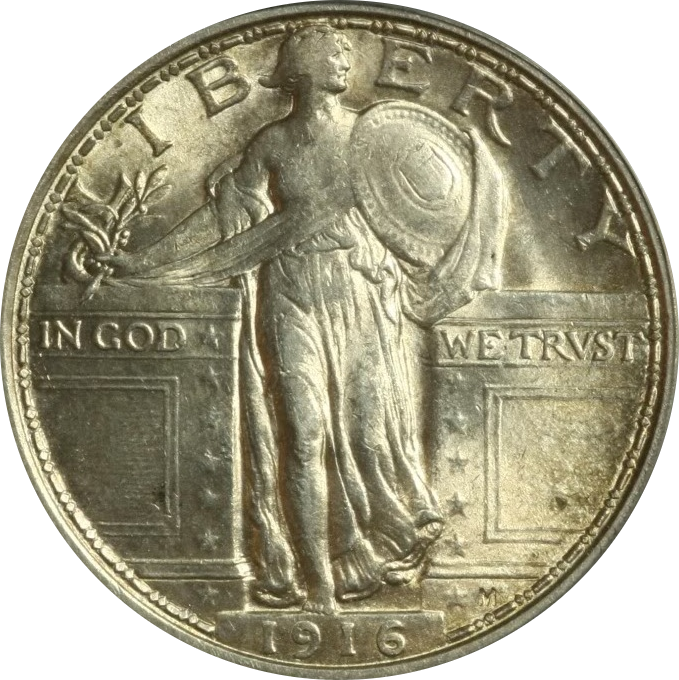
The 1916 Standing Liberty quarter obverse, from our media library.
If you’d like more coin collecting tips, listen to The Coin Show, a friendly coin collecting podcast for collectors at every level. Episodes mix collecting advice, mint news, and history. If you want more numismatic podcast listening while you sort your jars, find the show at coinshowradio.com.
Sources
- CoinWeek: Pulaski 1836 half eagle
- Numismatic News: Bargain Collector on Barber dimes
- CoinWeek: ANA dues increase
- Canadian Coin News: Scarborough Coin Club show
- GreatCollections weekly top ten
- CoinNews live spot prices
- CoinShows.us next 30 days
- NGC counterfeit detection resources
- ANA grading standards
- The Coin Show: Storing your coin collection