The Daily Mint — Tuesday, November 10, 2026: The Spy Coin Hiding in a Brooklyn Boy’s Pocket, An Eliasberg Proof Half Dollar Returns to Auction, and a Tuesday No-PVC Check
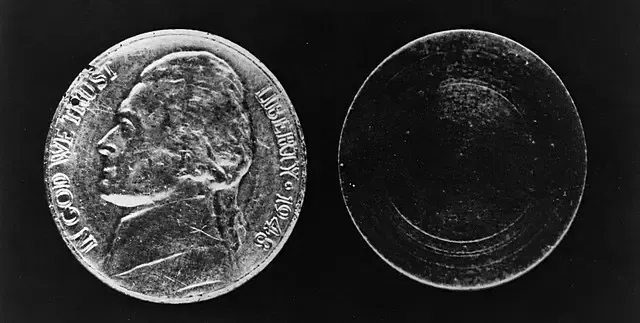
Image: FBI, via CoinWeek. The hollow 1948 Jefferson nickel that started the FBI's Hollow Nickel Case, shown in the bureau's original investigative photograph.
Today, Tuesday, November 10, 2026, we’re looking at a nickel that fell apart in a Brooklyn paperboy’s pocket and helped expose a Soviet master spy. Its finder, James “Jimmy” Bozart, died at 86 last month. Also today: an Eliasberg-pedigreed Proof Barber half dollar returns to auction November 17, plus our usual no-PVC check and a list of weekend coin shows. The Coin Show covers the hobby on our podcast and blog, with news, history, and practical coin collecting tips.
The Nickel That Fell Apart, and the Spy It Unmasked
A curious sound in a Brooklyn hallway
On the evening of June 22, 1953, Brooklyn Eagle newspaper boy Jimmy Bozart was collecting subscription payments at 3403 Foster Avenue in Brooklyn. He needed change for a dollar, and two women in the hallway helped him out. One nickel sounded wrong and felt light. When Jimmy dropped it, it split in two, revealing a tiny microphotograph covered in rows of numbers.
It was only three days after Julius and Ethel Rosenberg were executed. Word of the strange coin reached a schoolmate’s father, a New York City police officer. A detective told an FBI agent on June 24. Two days later, the FBI Laboratory in Washington began examining it.
A nickel assembled from two different coins
The device combined parts from two Jefferson nickels. Its obverse came from a genuine 1948 coin, made of 75% copper and 25% nickel. The reverse came from a 1942–1945 wartime nickel, struck in an alloy of 35% silver, 56% copper, and 9% manganese. The Mint had removed nickel during World War II to conserve the strategic metal.
A tiny hole inside the R of TRUST let an operative insert a needle and separate the halves. An ordinary Jefferson nickel measures 21.21 mm and weighs 5.00 grams; the modified coin weighed less. Inside were ten columns of typewritten numbers, most with 21 five-digit groups. The FBI investigated for nearly four years without decoding the message.

Image: CoinWeek. An ordinary 1948 Jefferson nickel: the coin whose design was borrowed for one of the Cold War's most unusual concealment devices.
Hollow nickel quick specs
- Obverse: 1948 Jefferson nickel; 75% copper, 25% nickel; standard weight 5.00 g and diameter 21.21 mm.
- Reverse: 1942–1945 wartime silver-alloy nickel; 35% silver, 56% copper, 9% manganese.
- Hidden opening: inside the R of TRUST.
- Classification: privately altered composite coin, not a Mint error.
The message points to an undercover officer
In May 1957, Soviet lieutenant colonel Reino Häyhänen defected. He had been in the United States since October 1952 under the name Eugene Nicolai Maki and arrived in New York on May 10, 1957. At his Peekskill, New York, home, agents found a hollow Finnish 50-markka coin built using the same concealment method. Its opening was hidden inside the first letter “a” of Tasavalta.
Häyhänen helped investigators decipher the nickel’s message by June 3. It was an administrative note welcoming a newly arrived officer. It mentioned $3,000 in local currency, photographic and encryption materials, and reassurance about the officer’s family. The note apparently belonged to Häyhänen himself.
His information led the FBI to Emil R. Goldfus, an artist-photographer with a fifth-floor studio at 252 Fulton Street in Brooklyn. Goldfus was really Vilyam Genrikhovich Fisher, a senior Soviet officer who used the name Rudolf Ivanovich Abel. Arrested June 21, 1957, he was convicted on three conspiracy counts on October 25 and sentenced to 30 years on November 15.
His attorney, James B. Donovan, argued against execution and predicted a future prisoner exchange. The Supreme Court upheld Fisher’s conviction 5–4 on March 28, 1960. After Francis Gary Powers’ U-2 was shot down on May 1, 1960, Fisher and Powers were exchanged on the Glienicke Bridge on February 10, 1962. The story later reached a wider audience in Steven Spielberg’s 2015 film Bridge of Spies, with Tom Hanks as Donovan.
Bozart died October 5, 2026, at 86, according to his obituary. He never decoded the message, but his curiosity started the chain.
Beginner tip: Coins can be altered or composited for reasons that have nothing to do with the Mint. If a coin looks, sounds, or weighs wrong, don’t clean it or spend it. Get a professional look first.
An Eliasberg Proof Barber Half Dollar Comes Home to Auction
From the Philadelphia Mint to a landmark collection
Stack’s Bowers will offer an 1897 Proof Barber half dollar, graded NGC Proof-68★ Cameo, as Lot 2063 in its November 2026 Rarities Night session on Tuesday, November 17. The coin comes from the Mack C. Chase Collection.
The Mint struck just 731 Proof Barber half dollars in 1897, compared with 2,480,000 circulation strikes. Collector John M. Clapp bought this Proof directly from the Philadelphia Mint in November 1897. After his death, his son John H. Clapp continued the collection. In 1942, Baltimore financier Louis E. Eliasberg, Sr. bought the Clapp estate holdings through Stack’s for a reported $100,000-for the collection, not this coin.
Eliasberg completed the only collection of every regular-issue U.S. coin by date and mintmark in 1950. The half dollar appeared as Lot 2079 in Bowers and Merena’s April 1997 Eliasberg sale, later joined the Hugon Collection, and sold as Lot 4277 in Heritage’s January 2005 FUN Signature Sale.

Image: Stack's Bowers, via CoinWeek. The Eliasberg-Hugon 1897 Proof Barber half dollar, NGC Proof-68★ Cameo, Lot 2063 in Stack's Bowers' November 17 Rarities Night session.
What makes this Proof stand out
NGC reports seven Proof-68 Cameo examples, four with the Star designation, and none finer in the Cameo category. PCGS reports three at Proof-68 Cameo, none finer. The coin has bright silver-white centers, reddish-apricot peripheral toning, and strong cameo contrast.
Charles E. Barber’s designs debuted in 1892. Liberty wears 13 six-pointed stars on the obverse; the reverse eagle has 13 five-pointed stars. That difference was deliberate, following an 1891 decision by Mint Director Edward O. Leech, not a mistake. Around 1902, the Mint shifted to brilliant Proofs, and deeply contrasted Deep or Ultra Cameo examples virtually disappear after that. The 1890s Proofs offer a special look at that earlier style.
The Proof Barber half dollar series spans 24 dates, 1892–1915. Annual Proof production was generally 500–900, with 1,245 in 1892. This coin is 90% silver and 10% copper, weighs 12.50 g, measures 30.6 mm, has a reeded edge and contains 0.3617 troy oz of silver. Its die attribution is JD-1, Rarity-2.
Beginner tip: A low mintage alone doesn’t set a coin’s price. Grade, eye appeal, and provenance matter, too. This Proof’s appeal comes from all three; 731 made means little if a coin is impaired.
Quick news notes
- Metals check: Gold eased toward $4,080–$4,090 per ounce Tuesday, and silver hovered near $52 after Monday’s bounce. Traders are waiting on this week’s U.S. inflation data. Kitco
- The Royal Mint’s Una and the Lion design made its bullion coin debut November 9, after 187 years. The 1 oz silver, 1 oz gold, and 1/10 oz gold coins are offered through an exclusive SD Bullion partnership. The original 1839 five-pound gold piece had output of about 300–500 coins; an exceptional example sold for £420,000 in 2019. CoinWeek
- Numismatic News published Part 2 of Rick Melamed’s Hawaiian currency history on November 10, covering territorial National Bank notes, World War II emergency overprints, and Depression-era scrip. Numismatic News
- Richard Giedroyc’s “Around the World” column reports gold coin sales up and jewelry demand down in China as investors shift to bullion coins and bars. Numismatic News
Counterfeit coin detection: a quick checklist
The hollow nickel was a privately altered composite coin, not a Mint error. It’s a reminder that altered coins aren’t always made for profit. For counterfeit coin detection, start with these checks:
- Weigh and measure against official specifications. An ordinary Jefferson nickel is 5.00 g and 21.21 mm.
- Know wartime 1942–1945 nickels: they contain 35% silver and have a large mintmark above Monticello. A mixed-composition nickel is a red flag.
- Check whether both faces belong to the same design era and whether the edge is undisturbed.
- Stop if you notice a hole, seam, or change in sound.
- Wartime silver nickels are worth more than face value. Don’t spend one.
- Never clean a suspect coin. Cleaning can destroy value and evidence.
- Ask a professional or submit it to a grading service.
See NGC’s counterfeit detection guide.
ANA grading standards, in plain groups
These ANA grading standards make a useful first reference:
- AG-3 to G-6: Heavy wear; outlines remain.
- VG-8 to F-15: Major details are visible.
- VF-20 to EF-45: Most detail remains, with light wear.
- AU-50 to AU-58: Full detail, with traces of wear on high points.
- MS-60 to MS-70: Uncirculated; 70 is flawless.
Proof describes a strike type, not a condition. Modern Proof coins use PR-60 to PR-70 grades. NGC’s ★ Star designation signals exceptional eye appeal, as on the 1897 half dollar above. Details grades are assigned to problem coins that can’t receive a numerical grade. Read more in our guide to the official ANA grading standards.
Tuesday no-PVC check
Vinyl flips can cause coin PVC damage over time. For coin storage for collectors, choose PVC-free materials such as Mylar, polyethylene, polypropylene, or hard acrylic. If you see green residue or slime on a coin, don’t rub it off; ask a professional to evaluate it. For more on how to store coin collection safely, see our full storage guide.
What is a coin show? And where to go next weekend
If you’re wondering what is a coin show, think of it as a bourse: dealers buy, sell, and appraise coins, while club shows are often run by volunteer collectors. Here are listings for Saturday, November 14, and Sunday, November 15. Confirm hours and venues with the organizer before you travel. Check the full show calendar.
Saturday, November 14
- Cleveland Coin Expo: Woodside Event Center at St. Michael’s, Broadview Heights, OH.
- Big Flats Coin Club Coin Show: American Legion Post, Big Flats, NY (free entry).
- Charleston Area Coin Show: Tyler Mountain Community Center, Cross Lanes, WV (free entry).
- Marion Coin Club Annual Coin Show: Grant County 4H Fairgrounds, Marion, IN.
- Norfolk Coin Show: VFW, Norfolk, VA (free entry).
- Tampa Stamp & Coin Expo: Sons of Italy Lodge, Tampa, FL.
- Coins, Cards & Chaos: Valley Forge Casino Resort, King of Prussia, PA (also Sunday).
Sunday, November 15
- BNA Coin & Currency 3rd Sunday Bourse: The Knights Event Center, Cheektowaga, NY (free entry).
- Cromwell-Hartford Coin & Currency Show: Courtyard Marriott, Cromwell, CT (free entry).
- Fort Lauderdale Coin Show: Volunteer Park Center, Plantation, FL (free entry).
- Old Bridge Coin, Paper Money & Collectibles Show: Old Bridge First Aid & Rescue Squad Building, Old Bridge, NJ (free entry).
- Omaha Monthly Coin & Collectibles Show: Bel-Air Banquet Room, Omaha, NE (free entry).
- Phoenix Area Coin Show: El Zaribah Shrine Auditorium, Phoenix, AZ.
- ONA Coin and Currency Show: Holiday Inn, Liverpool, NY (free entry).
Also coming up: The Whitman Baltimore Expo runs November 12–14 at the Baltimore Convention Center, with free admission.
Standing Liberty Quarter 1916 reminder
The standing liberty quarter 1916 was the first year of Hermon MacNeil’s design. These quarters were struck only in Philadelphia, which did not use a mintmark then. With a mintage of just 52,000-the lowest of the series: it’s a key date. A genuine example is a five-figure coin in nearly any grade. Never clean one. If you think you’ve found one, get it authenticated.
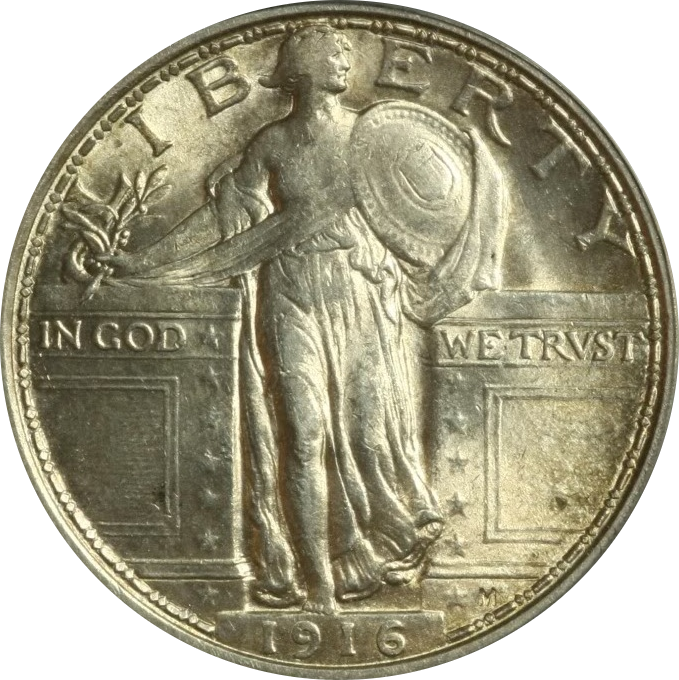
Image: The Coin Show media library. The 1916 Standing Liberty quarter, the key date of the series.
Join The Coin Show, our coin collecting podcast, where the hosts talk mint releases, rare finds, and coin collecting tips in every episode. It’s also available as a numismatic podcast on all major apps. Visit coinshowradio.com.
Sources
- CoinWeek: The Hollow Nickel Case
- CoinWeek: 1897 Barber half dollar heads to auction
- CoinWeek: Royal Mint revives Una and the Lion
- Numismatic News: Hawaiian currency history, Part 2
- Numismatic News: Gold coin sales up, jewelry demand down in China
- Kitco
- CoinShows.us: Next 30 days
- NGC: Counterfeit detection
- The Coin Show: Storing Your Coin Collection
- The Coin Show: Official ANA Grading Standards