The Daily Mint — Wednesday, November 11, 2026: The Finest Sacagawea Mule Goes to Auction, Why 1982 Cents Are a Collector’s Sampler Pack, and a Wednesday No-PVC Check
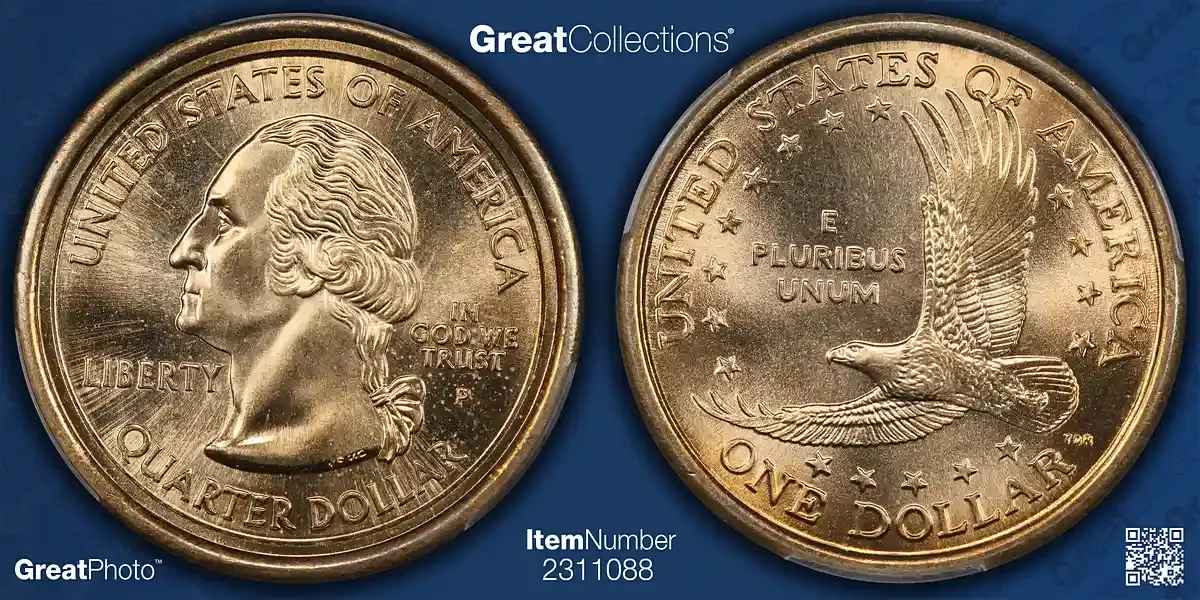
Image: GreatCollections, via CoinWeek. The 2000-P Sacagawea dollar mule with a Washington quarter obverse, PCGS MS-67, closing December 13 at GreatCollections.
Welcome to Wednesday’s Daily Mint. A famous error coin is headed to auction, 1982 cents offer an affordable collecting project, and we have a midweek no-PVC check for your collection. We’re sharing these stories and practical coin collecting tips from The Coin Show, your coin collecting podcast.
The $1.25 Coin: Finest PCGS Sacagawea Mule Headlines GreatCollections
A 2000-P Sacagawea dollar mule graded PCGS MS-67 is set to close in a GreatCollections auction on Sunday, December 13, at about 6:30 p.m. Pacific. GreatCollections calls it the finest example PCGS has graded. It’s listed as item 2311088, with PCGS certification number 63574373 and PCGS number 508061.
A mule with two denominations
A mule is a coin struck with two dies the Mint never intended to pair. Here, a Washington quarter obverse meets the Sacagawea dollar reverse. John Flanagan designed the Washington portrait, later adapted for the State Quarters program by William Cousins. Thomas D. Rogers Sr. designed the dollar’s soaring eagle and 17 stars.
The two inscriptions gave the coin its familiar nickname: the “$1.25 coin.” One side says QUARTER DOLLAR; the other says ONE DOLLAR. It is classified as a one-dollar coin because it was struck on a Sacagawea dollar planchet.
There’s no date on either side. Statehood quarters placed the date on the reverse, while the original Sacagawea dollar had it on the obverse. Pairing those designs left the mule dateless, though it retains the P mintmark.
Beginner tip: A mule pairs dies the Mint never meant to use together. This one is famous for mixing two denominations.
From a bank roll to a major rarity
In May 2000, Arkansas collector Frank Wallis found a mule in a bank roll of new Sacagawea dollars. The U.S. Mint confirmed the error was genuine on June 19. That August, Bowers and Merena sold the discovery coin at the ANA convention in Philadelphia for $29,900.
How did the mistake happen? The quarter measures 24.3 mm across, compared with 26.5 mm for the golden dollar. One theory suggests protective plastic covers concealed the die designs before installation. Error specialist Fred Weinberg has also pointed to employee rotation in the Mint’s die room in the late 1990s. Mint workers reportedly caught the error and destroyed many affected coins, but some escaped.
About two dozen examples are known across all grades and three die pairs. The auction coin is Die Pair 1. It can be identified by a crack crossing the F in OF on the reverse and radial die striations near the obverse border.
New Mexico collector Tommy Bolack assembled many known examples. The mule also took the top spot and cover position in 100 Greatest U.S. Error Coins (Whitman, 2010), by Nicholas Brown, David Camire, and Fred Weinberg.
Past sales show the interest in these unusual coins: the discovery specimen brought $29,900 in 2000; an NGC MS-67 sold for $192,000 in 2018; a PCGS MS-66 set a $194,062.50 record, including buyer’s premium, at GreatCollections in January 2024; and an NGC MS-67 realized $158,600 in Stack’s Bowers’ Summer 2026 Global Showcase. Those results are context, not a prediction for this auction.
The dollar’s manganese-brass cladding over a copper core gives both designs their golden color. It weighs 8.10 grams and has a plain edge.

Image: GreatCollections, via CoinWeek. The mule in its PCGS holder: 2000-P, MS-67, “Sacagawea Washington Quarter Mule.”
Seven Ways to Build One 1982 Cent Collection
The 1982 Lincoln cent is a handy collecting sampler. Rising copper prices led the Mint to switch from 95% copper cents weighing 3.11 grams to zinc cents with 2.5% copper plating, weighing 2.5 grams. Both compositions were struck that year, alongside large-date and small-date styles.
The seven circulating varieties are Philadelphia copper large date and small date; Philadelphia zinc large date and small date; Denver copper large date; and Denver zinc large date and small date. San Francisco also issued a proof cent, which you can add to a broader year set.
The cent’s composition had changed before. The Mint struck steel cents in 1943, used shell-casing alloy from 1944 to 1946, and dropped tin in 1962. In December 1973, the Treasury secretary received authority to change cent composition. More than a million aluminum cents were struck in 1974, then destroyed; a few survived as samples. A Research Triangle Institute report later recommended eliminating the cent, but officials resisted dropping Lincoln’s coin.
None of the regular 1982 varieties is rare, and a complete set is an affordable project. You can search pocket change or coin rolls, then sort candidates by date style and mintmark.
Beginner tip: A small kitchen or coin scale is the easiest way to separate the copper and zinc cents: 3.11 grams versus 2.5 grams.

Image: Numismatic News, courtesy Heritage Auctions. A 1982 Lincoln cent; seven circulating varieties of this date exist across copper and zinc compositions and two date sizes.
Quick news notes
- Metals check: Gold opened Wednesday near $4,054, up about 0.6%. Silver was near $53, up more than 3%, with platinum around $1,562 and palladium near $1,068. Traders are watching this week’s U.S. inflation data. Kitco
- Mint finish: The 2026 Morgan and Peace dollar Diamond Field two-coin set continues to draw attention for the Mint’s first diamond field finish. CoinWeek
- Vietnam Veterans Memorial dollar: A new CoinWeek profile looks at John Mercanti’s hand-touching-the-Wall obverse, Thomas D. Rogers Sr.’s three-medal reverse, and the headstone-coin tradition: a penny means you visited, a nickel means you trained with the person, a dime means you served with them, and a quarter means you were there when they died. CoinWeek
- Ancient coins: The American Numismatic Society will honor Basil Demetriadi, whose “BCD” initials have appeared in the provenance of important Greek coins for decades. CoinWeek
Counterfeit coin detection: a quick checklist
Famous errors can attract counterfeits and alterations. A quarter face glued or tooled onto a dollar may be made as a novelty, not necessarily to deceive someone for profit. Either way, take care before calling an unusual coin a genuine mule.
- Weigh and measure it against official specifications: a Sacagawea dollar is 8.10 grams and 26.5 mm; a Washington quarter is 5.67 grams and 24.3 mm.
- Check whether both faces belong to the same design era.
- Inspect the edge: the dollar is plain-edged; the quarter is reeded.
- Look for seams, glue lines, or tool marks.
- Have a suspected mule authenticated by PCGS, NGC, or CACG.
- Don’t clean a suspect coin. Ask a professional for an opinion.
For more on counterfeit coin detection, see NGC’s guide.
ANA grading standards, in plain groups
The ana grading standards are easier to follow when you think in broad ranges:
- AG-3 to G-6: Heavy wear. The design is mostly reduced to outlines.
- VG-8 to F-15: Major details are visible, though still worn.
- VF-20 to EF-45: Details are clear, with wear on the high points.
- AU-50 to AU-58: Light friction remains. Luster may be reduced or still visible.
- MS-60 to MS-70: Uncirculated, ranging from noticeable marks to near-flawless.
- Proof: A special strike type, not a condition grade.
“Details” grades describe coins with problems such as cleaning or damage. For a fuller reference, see our guide to official ANA grading standards.
Wednesday no-PVC check
Midweek is a good time to pull a few coins from long-term storage and inspect their flips. Vinyl holders containing PVC can release plasticizers over time. The residue may cause coin pvc damage, including a sticky film, green slime, or etching.
If you spot green residue, don’t rub it. Set the coin aside and get a professional evaluation. For coin storage for collectors, choose inert materials such as Mylar, polyethylene, polypropylene, or hard acrylic. Our guide explains how to store coin collection items safely.
What is a coin show? And where to go next weekend
A coin show is a gathering where dealers buy and sell coins, collectors meet, clubs share information, and grading services may accept submissions. Many shows welcome kids and first-time visitors. It’s a relaxed way to see a lot of coins and ask questions in person.
Here are listings for Saturday, November 14, and Sunday, November 15. Confirm hours and venues with organizers before you travel.
Saturday, November 14
- Cleveland Coin Expo, Broadview Heights, OH; Woodside Event Center at St. Michael’s.
- Big Flats Coin Club Coin Show: Big Flats, NY; American Legion Post; free entry.
- Charleston Area Coin Show, Cross Lanes, WV; Tyler Mountain Community Center; free entry.
- Marion Coin Club Annual Coin Show: Marion, IN; Grant County 4H Fairgrounds.
- Norfolk Coin Show, Norfolk, VA; VFW; free entry.
- Tampa Stamp & Coin Expo: Tampa, FL; Sons of Italy Lodge.
- Coins, Cards & Chaos, King of Prussia, PA; Valley Forge Casino Resort; also Sunday.
- Watertown Cards, Coins & Collectibles Show: Watertown, NY; Faichney Drive Business Complex.
- Grand Rapids Monthly Coin Show: Walker, MI; Neil Fonger American Legion Post 179.
Sunday, November 15
- BNA Coin & Currency 3rd Sunday Bourse: Cheektowaga, NY; The Knights Event Center; free entry.
- Cromwell-Hartford Coin & Currency Show: Cromwell, CT; Courtyard Marriott; free entry.
- Fort Lauderdale Coin Show: Plantation, FL; Volunteer Park Center; free entry.
- Greensburg Coin Club Coin Show: North Huntington, PA; Circleville Fire Hall.
- Peterborough Fall Coin Show, Peterborough, ON.
- Coin Cabinet Collector Show, Moncton, NB.
- Salon du collectionneur de Rimouski: Rimouski, QC.
Also on the calendar: the Whitman Baltimore Expo, November 12–14; Collectorama in Lakeland, FL, November 12–14; and the Tennessee State Numismatic Society Fall Convention in East Ridge, TN, November 12–14. Check the coin shows listing for updates.
Standing Liberty Quarter 1916 reminder
The 1916 Standing Liberty quarter is the key date of the series and the first year of Hermon MacNeil’s design. Philadelphia struck just 52,000, the series’ lowest mintage. The coin has no mintmark, as Philadelphia didn’t use one.
It’s a five-figure coin in nearly any grade. Never clean one. If you think you’ve found a standing liberty quarter 1916, have it authenticated before making decisions about it.
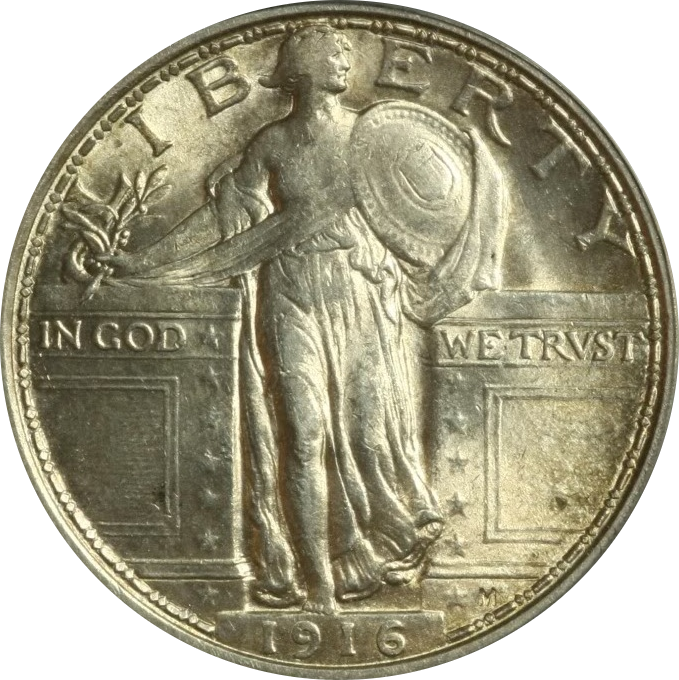
The obverse shows the 1916 date.
Listen to The Coin Show
For entertaining coin talk, more coin collecting tips, and interviews, listen to The Coin Show, our coin collecting podcast and numismatic podcast for every level of collector. You can also watch video episodes on our YouTube channel.
Sources
- CoinWeek: Sacagawea mule auction
- Numismatic News: Seven 1982 cent varieties
- CoinWeek: 1994-W Vietnam Veterans Memorial dollar
- CoinWeek: Basil Demetriadi
- CoinWeek: Diamond Field finish
- Kitco: Metals prices
- CoinShows.us: Next 30 days
- NGC: Counterfeit detection
- The Coin Show: Storing your coin collection
- The Coin Show: Official ANA grading standards