
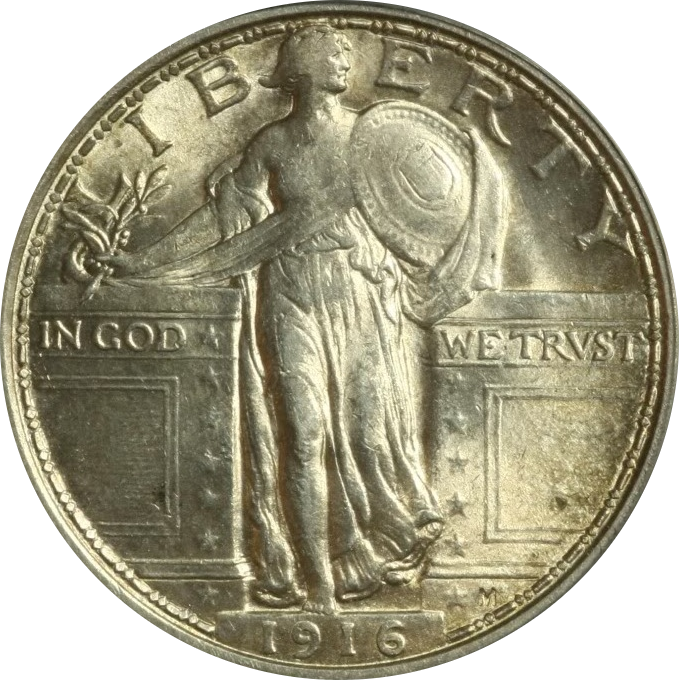
Why Everyone Is Talking About the Standing Liberty Quarter 1916 (And How to Spot the Real Deal)
If you have spent any time hanging around a coin show or listening to a numismatic podcast, you have probably heard someone mention the 1916 Standing Liberty Quarter. It is one of those "holy grail" coins that collectors whisper about. It has everything: a tiny mintage, a scandalous design history, and a price tag that can make your eyes water even for a heavily worn specimen.
Welcome to "The Daily Mint," our daily dive into the world of coin collecting. Today, we are breaking down why this specific quarter is such a big deal and how you can make sure you are looking at the real thing instead of a clever fake or a misidentified 1917.
A Design Born in Controversy
To understand why people love the 1916 Standing Liberty Quarter (SLQ), you have to go back to when it was created. In 1916, the U.S. Mint was transitioning away from the Barber designs that had been around for 25 years. They tapped sculptor Hermon A. MacNeil to create something new for the quarter.
MacNeil’s design was a masterpiece of the Beaux-Arts style. It featured Liberty standing in a gateway, holding a shield and an olive branch. It was beautiful, but it was also brief. The original design: which we now call "Type 1": featured Liberty with an exposed right breast.
By early 1917, public complaints (and a desire to make the coin more "modest") led to a redesign. Liberty was given a suit of chain mail to cover up, and the stars on the reverse were moved around. Because the 1916 issue was struck only in the final two weeks of the year, it carries that original, short-lived "bare breast" design.
The Scarcity Factor: Only 52,000
The main reason the 1916 is so famous isn't just the design: it is the numbers. The Mint struck only 52,000 of these quarters. To put that in perspective, they struck over 12 million quarters the following year.
Because these were released right at the end of the year without much fanfare, most of them went straight into circulation. People spent them on groceries and newspapers, unaware they were handling a future rarity. This means that finding a 1916 SLQ in high grade is incredibly difficult, and even "slick" coins with almost no detail left can still sell for thousands of dollars.
1916 vs. 1917: Telling the Twins Apart
The biggest challenge for collectors is that the 1916 and the early 1917 (Type 1) look almost identical at first glance. Both have the exposed breast and the same star pattern on the back. If the date is worn off: which happens a lot with these coins: you have to look at the tiny details.

The Hair Curl Test
On a genuine 1916 quarter, Liberty has one distinct, thick hair curl on the side of her head. If you look at a 1917 Type 1, the hair detail is different, usually showing more complexity or multiple curls.
The Foot and the Gown
Look at where Liberty’s gown meets her right foot. On the 1916, the drapery of the gown flows directly into her foot. On the 1917, the gown actually curls upward slightly before it reaches the foot. It is a subtle difference, but for a coin worth this much, every millimeter matters.
Spotting the Real Deal (and Avoiding Fakes)
Because the 1916 is so valuable, it is a prime target for counterfeiters. The most common "fake" isn't a fake coin at all: it is a 1917 Type 1 that someone has "tooled" to look like a 1916.
Altered Dates
Under a magnifying glass, check the metal around the last digit of the date. If you see tiny scratches, uneven surfaces, or a "scooped out" look, someone may have scraped away the '7' to make it look like a '6'. The wear on the date should always match the wear on the rest of the coin. If the coin is beat up but the "1916" looks crisp and new, run away.
Casting Signs
Some fakes are made by casting the coin in a mold. These often look "mushy." The edges of the letters and stars won't be sharp, and you might see tiny pits (bubbles) on the surface. Genuine U.S. coins are struck with massive pressure, giving them sharp, clean lines.

Coin Care: The PVC Nightmare
Whether you have a 1916 SLQ or just some silver you found in a jar, how you store your collection matters. We see a lot of "environmental damage" at coin shows, and much of it comes from old-school plastic flips.
Many older soft plastic holders contain PVC (polyvinyl chloride). Over time, the chemicals in the plastic break down and leak onto the coin. It starts as a green, sticky, or oily residue: often called "green slime." If you don't catch it, it will eventually eat into the metal and permanently pit the surface of the coin.
Coin Collecting Tip: Only use "PVC-free" or "non-PVC" flips and holders. Hard plastic capsules or archival-quality flips are the way to go. If you find a coin with green residue, do not try to scrub it off with a toothbrush. You will just scratch the coin and ruin its value. Instead, look into professional conservation services or talk to an expert at a coin show.
ANA Standards and the "Full Head"
When you are looking at high-end 1916 quarters, you will see a lot of people talking about the "Full Head" (FH) designation. This is based on the American Numismatic Association (ANA) grading standards.
Because the 1916 was often weakly struck, the details of Liberty's head are frequently flat, even on coins that never saw circulation. A "Full Head" coin is one where you can clearly see the hairline, the ear, and the leaves in her hair. These coins are the "best of the best" and command a massive premium over standard strikes.
Join the Conversation
The 1916 Standing Liberty Quarter is a piece of American history you can hold in your hand. It represents a time of artistic change and a brief moment of design controversy that still fascinates collectors over a century later.
If you want to learn more about rare finds or get more coin collecting tips, check out our latest episodes on the podcast. We talk about everything from modern mint releases to the deep history of the hobby.
Have you ever found a "dateless" Standing Liberty Quarter? Drop us a line or come see us at the next show!