
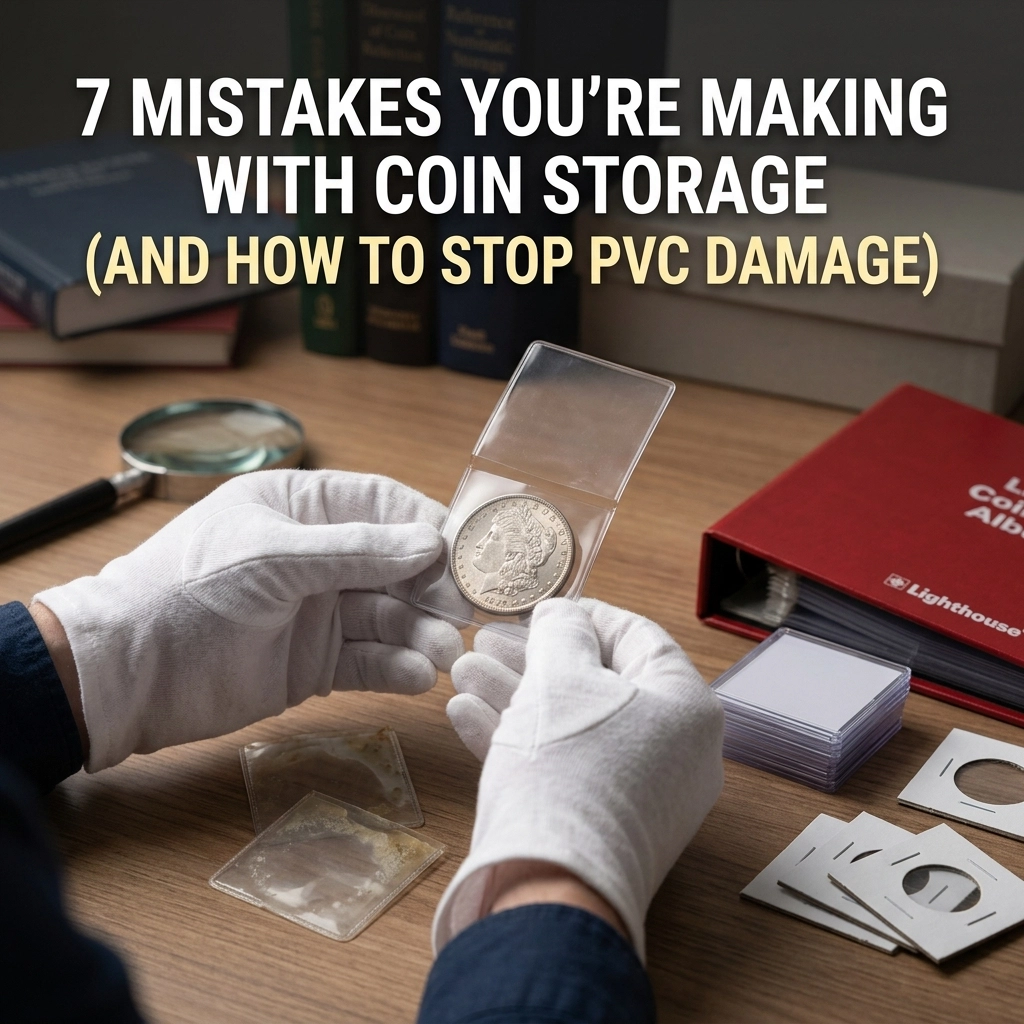
7 Mistakes You’re Making with Coin Storage (And How to Stop PVC Damage)
Hey there, fellow collectors! Welcome to another edition of The Daily Mint. If you’ve been hanging out with us on The Coin Show, you know we’re obsessed with the history, the hunt, and the "thrill of the find." But there is one thing that can turn a "find of a lifetime" into a "lesson learned the hard way" faster than a counterfeit trade dollar: bad storage.
Think about it. You spend years hunting down that perfect Standing Liberty Quarter 1916 or a crisp Mercury dime, only to pull it out of a drawer five years later and find it’s turned a sickly, sticky shade of green. It’s a heartbreak we’ve all felt at least once.
Today, I’m putting on my numismatic protective gear to walk you through the seven biggest mistakes people make when storing their collections. Plus, we’re going to do a deep dive into the "Green Slime": otherwise known as PVC damage: and how you can stop it before it eats your investment alive.
1. The "Golden Touch" (Handling with Bare Hands)
We get it. You just bought a beautiful new piece and you want to feel the weight of history in your palm. But unless you’re holding a common pocket change junk silver coin, keep your hands off.
Your skin is a literal factory for oils, salts, and acids. Even if you just washed your hands, your skin is constantly producing moisture. When you touch the surface of a coin, those oils transfer to the metal. At first, you won't see anything. But over time, those oils react with the copper or silver, leaving a permanent, dark fingerprint that can never be truly removed without "cleaning" the coin (which, as we know, is the cardinal sin of numismatics).
The Fix: Invest in a box of lint-free white cotton gloves. If you prefer a better grip, medical-grade nitrile gloves (powder-free!) work wonders. If you absolutely must use your hands, always hold the coin by the edges: never the face.
2. The PVC Nightmare
This is the big one. If you’ve ever bought coins in those soft, pliable plastic "flips," you might be sitting on a ticking time bomb. Many of those soft holders are made with Polyvinyl Chloride (PVC). Manufacturers add chemicals called plasticizers to make the PVC flexible.
Over time, these chemicals break down and release acidic gases. This creates a sticky, green residue on the surface of the coin. If left long enough, that acid will actually pit the metal, permanently damaging the coin’s surface and destroying its value.
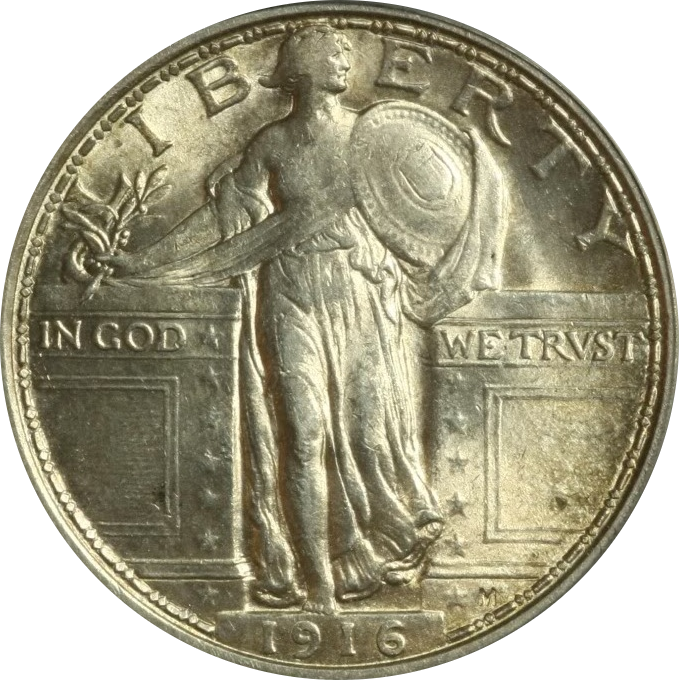
The 1916 Standing Liberty Quarter is a masterpiece of design. Imagine ruining those fine details with a layer of green slime. It’s a nightmare no collector should face.
The Fix: Check your flips. If they are soft and oily to the touch, or smell like a new shower curtain, get your coins out of there immediately. Use "unplasticized" flips (often called Mylar flips) or hard plastic capsules.
3. The "Ziploc" Strategy
We see this a lot with new collectors who have just inherited a collection. They put everything into food-grade plastic bags. While a Ziploc is great for a ham sandwich, it’s terrible for a 1794 Flowing Hair Silver Dollar.
Food bags aren't airtight, they offer zero physical protection against scratches, and they often contain the very same PVC we just warned you about. When coins are jumbled together in a bag, they rub against each other, creating "bag marks" and hair-line scratches that can drop a coin from an MS65 to an MS60 in a heartbeat.
The Fix: Use individual storage. Cardboard 2x2s with Mylar windows are the gold standard for budget-friendly storage. They allow you to label the coin while keeping it safe from its neighbors.
4. Rubber Bands are the Enemy
This is a classic "Grandpa’s desk drawer" mistake. You have a stack of coin tubes or a few folders, and you wrap a rubber band around them to keep them tight.
Rubber contains sulfur. As the rubber band ages and starts to dry out, it off-gasses that sulfur into the air. Sulfur is the primary cause of heavy, ugly toning on silver and copper. In extreme cases, the rubber band will actually melt and fuse to the coin folder or the coins themselves.
The Fix: Use archival-safe boxes or plastic bins to keep your tubes organized. If you need to bundle things, use cotton string or acid-free paper tape.
5. Ignoring the Environment (Attics and Basements)
Humidity is the silent killer of a great collection. Many people store their coins in a basement (too damp) or an attic (too hot).
High humidity leads to oxidation and can accelerate the breakdown of even "safe" plastic holders. On the flip side, extreme heat can cause some storage materials to "outgas" chemicals faster than they would at room temperature.
The Fix: Keep your coins in a "climate-controlled" environment. Usually, the same room you sleep in is the best place for them. If you use a safe, make sure to include a silica gel dehumidifier pack to soak up any excess moisture.
6. The "Jar of Change" Mentality
Even if your coins aren't rare yet, treating them like "just change" is a bad habit. Dumping coins into a glass jar leads to "rim dings" and surface scratches. When you eventually decide to take those coins to a coin show or look into counterfeit coin detection, you'll want your pieces to be in the best condition possible.
The Fix: If you have bulk coins, use plastic coin tubes. They are inexpensive and prevent the coins from rattling against each other.
7. Cracking the Slab Without a Plan
Professional grading is a huge part of the hobby. Companies like PCGS and NGC provide a guarantee of authenticity and grade based on ANA grading standards. Sometimes, collectors see a coin in a "slab" and think, "I want to put this in my album," so they crack it open.
Unless you are an expert, cracking a slab is risky. You could scratch the coin in the process, and you instantly lose the "authenticated" status. For a high-value coin like a 1796-5 Half Eagle, that slab is your insurance policy.
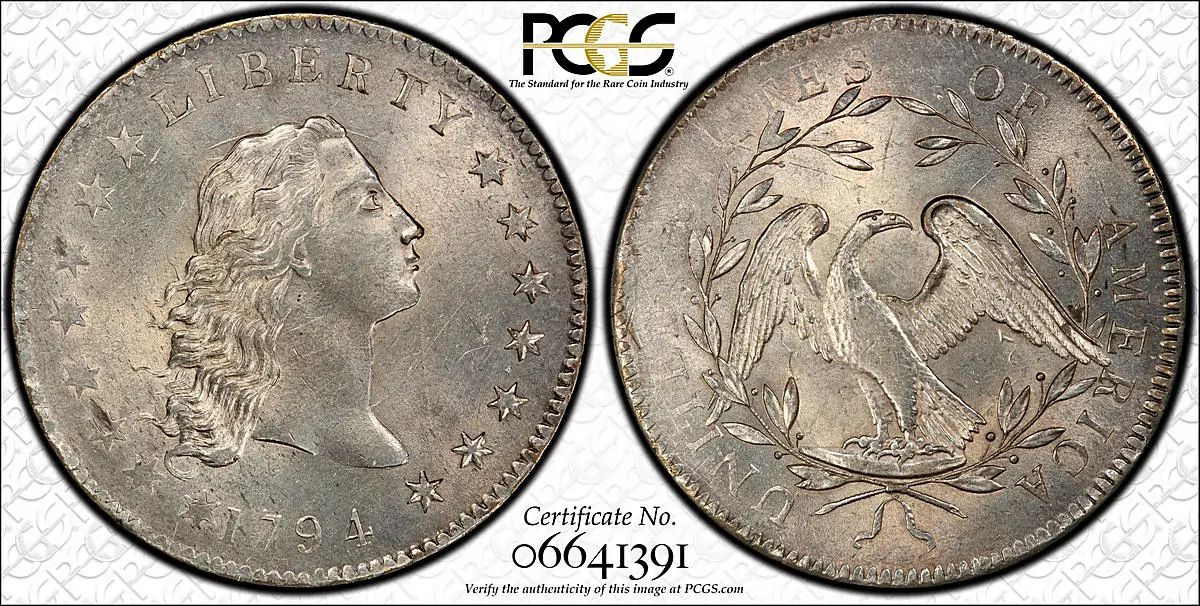
High-value coins like this 1794 Flowing Hair Silver Dollar are almost always found in protective slabs. This protects the 4.5 million dollar investment from the elements and human error.
The Fix: If you want a coin for an album, try to buy one that is already "raw" (un-graded). If you must crack a slab, do it carefully with the right tools, and only if you’re certain you don't plan on reselling it as a graded piece anytime soon.
How to Stop and Fix PVC Damage
So, what do you do if you find that dreaded green goo?
First, don't panic. If the damage is caught early, the "green" is just a surface residue and hasn't yet started eating the metal.
The Remedy:
The standard treatment among professional numismatists is a bath in 100% pure acetone.
Note: Do NOT use nail polish remover; it contains perfumes and oils.
- Safety First: Acetone is highly flammable and the fumes are strong. Work outside or in a very well-ventilated area. Wear eye protection.
- The Soak: Place the affected coin in a small glass container with enough pure acetone to cover it. Let it soak for a few minutes.
- The Rinse: Swirl the coin gently. The acetone should dissolve the PVC residue.
- Air Dry: Take the coin out (using tongs or gloved hands) and let it air dry. Do not rub the coin with a cloth!
If the green residue is gone and the metal underneath looks bright and clean, you’ve saved it! If you see tiny pits or "gray" spots, the acid has already done its work. At that point, the coin is considered "environmental damage" by grading standards, but stopping the process now will prevent it from getting worse.
Why This Matters
Whether you're listening to a numismatic podcast while sorting through wheat pennies or you're hunting for a 1776-2026 Emerging Liberty Dime, the goal is the same: preservation.
We often talk about "What is a coin show?" on our coin show (the podcast, not the event!). A coin show is a gathering of history. When you walk onto that floor, you are seeing pieces of the past that have survived wars, depressions, and simple neglect. Our job as collectors is to be the next link in that chain.
By following these coin collecting tips, you aren't just "organizing a hobby." You are protecting a legacy. Proper coin storage for collectors is the difference between a collection that appreciates in value and one that ends up in the "cull" bin.
Final Thoughts
If you're ever in doubt about a storage solution, ask yourself: Is this archival quality? If the answer isn't a definitive "Yes," keep it away from your coins.
We cover topics like this and more on The Coin Show. If you haven't subscribed to our coin collecting podcast, you’re missing out on deep dives into ANA grading standards, tips for counterfeit coin detection, and stories about the rarest coins in the world.
Go check your collection tonight. Check those flips, throw away those rubber bands, and move that box out of the basement. Your future self (and your wallet) will thank you.
Happy hunting, and keep 'em shiny!