
7 Mistakes You’re Making with Coin Storage (And Why PVC is Your Worst Enemy)
Hey everyone, welcome back to another edition of The Daily Mint. If you’ve spent any time listening to Matt Dinger on our coin collecting podcast, you know we talk a lot about the thrill of the hunt. Finding that perfect date, that high-grade luster, or that elusive variety is what keeps us all going. But there’s a darker side to the hobby that doesn’t get enough airtime: what happens after you buy the coin.
You can spend thousands of dollars on a collection, but if you aren’t thinking about how to store coin collection properly, you’re basically watching your investment dissolve in slow motion. Today, we’re diving into the seven most common mistakes collectors make with storage. And yes, we’re going to talk about the "Green Slime" that keeps numismatists up at night.
1. Falling for the PVC Trap
Let’s get the big one out of the way first. If you take away only one of our coin collecting tips today, let it be this: PVC is the enemy.
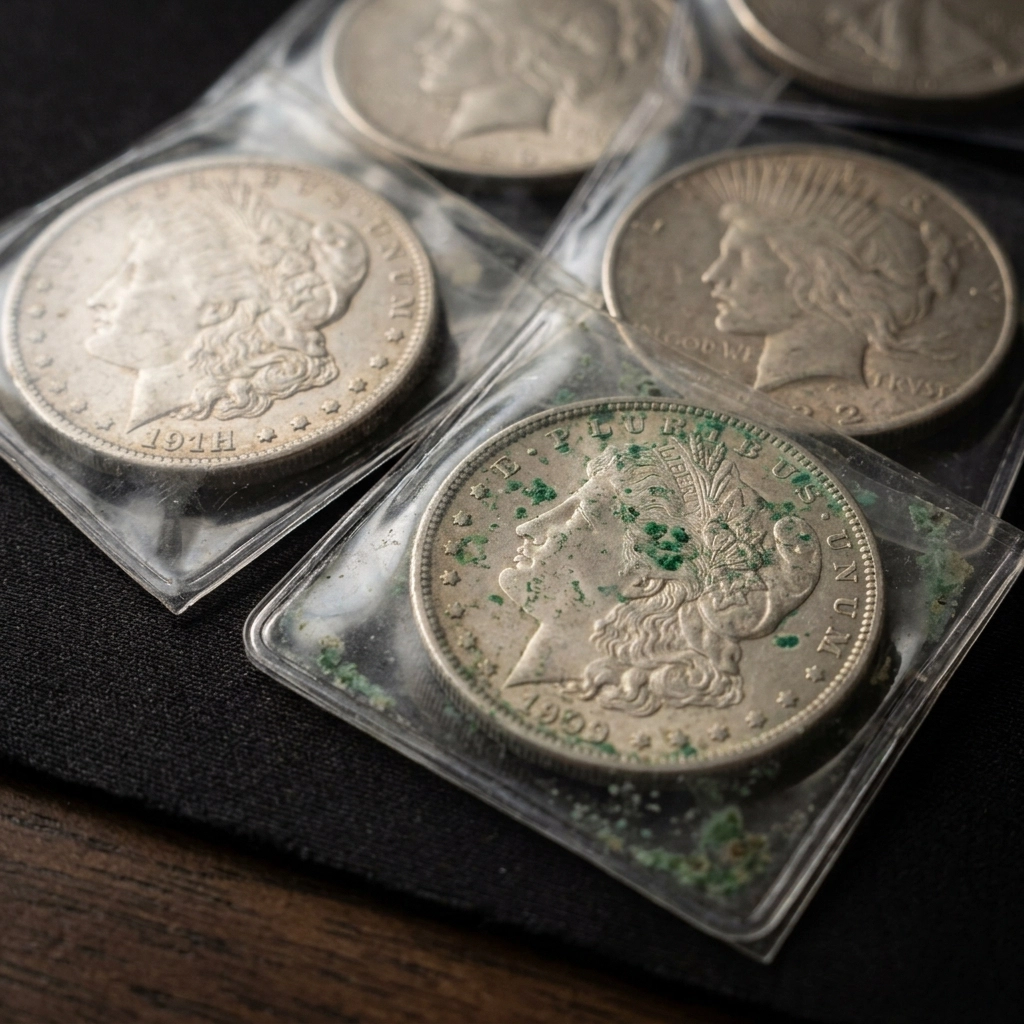
Many cheap, soft, pliable plastic flips are made with polyvinyl chloride (PVC). Manufacturers use chemicals called plasticizers to make the plastic soft and bendy. Over time, these chemicals break down and release acidic gases. This leads to coin pvc damage, which manifests as a sticky, green residue on the surface of your coins.
It’s not just ugly; it’s corrosive. If left long enough, it will eat into the metal, permanently altering the surface and destroying the coin's value. If you have coins in soft, "flipette" style holders that smell like a shower curtain, get them out of there immediately. Move them to archival-quality, non-PVC Mylar flips or hard plastic capsules.
2. Touching Coins with Your Bare Hands
We’ve all seen the movies where a guy holds a rare gold coin between his thumb and forefinger to show it off. In the world of high-end numismatics, that’s a horror movie.
Your skin is covered in natural oils, salts, and acids. When you touch a coin, you leave a microscopic footprint of these substances. Over months or years, those oils react with the metal. This is how you end up with a permanent, dark fingerprint on a beautiful proof coin.
According to ANA grading standards, surface preservation is everything. A single fingerprint can drop a coin’s grade by several points, potentially costing you hundreds or even thousands of dollars. When handling your coins, always hold them by the edges. Better yet, wear lint-free cotton gloves. If you're visiting a coin show and a dealer hands you a coin, show them you know your stuff by handling it with the respect it deserves.
3. The "Standing Liberty" Folder Mistake
We love folders. They’re great for kids starting a Whitman set of Lincoln Cents. But as your collection grows in value, the storage needs to grow too. A common mistake is putting high-value, delicate coins into cardboard folders where the reverse is exposed to the air and the obverse is subject to "sliding" friction.
Take the standing liberty quarter 1916 as an example. This is a legendary coin, the first year of a beautiful design. Because the 1916 has a very low mintage and the date was placed high on the design, it wore away almost instantly in circulation.
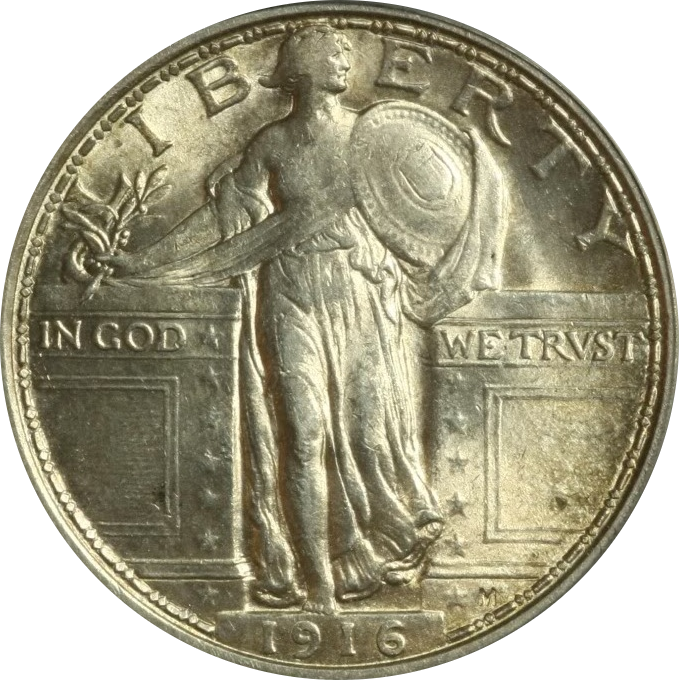
If you’re lucky enough to own a 1916 or even a high-grade 1917, putting it in a standard press-in folder is asking for trouble. The friction of pushing the coin into the hole can cause "cabinet friction," and the lack of a protective barrier means environmental contaminants can reach the metal. For coins of this caliber, you want airtight capsules or professional grading "slabs."
4. Storing Your Collection in the Wrong Climate
Where do most people keep their "valuables"? Usually the attic or the basement. For coins, these are essentially torture chambers.
Coin storage for collectors requires a stable environment. Attics get incredibly hot, which accelerates chemical reactions (like the PVC breakdown we mentioned). Basements are often damp, and humidity is the primary cause of unsightly spotting and heavy tarnish on silver and copper.
The ideal storage spot is a cool, dry place with a consistent temperature. If you live in a humid area, consider keeping silica gel packs inside your storage boxes to wick away moisture. Remember, silver loves to react with sulfur and moisture. If you don't control the air, the air will "redecorate" your coins for you.
5. Misunderstanding "What is a Coin Show" Education
Mistakes often happen because collectors don't stay educated. One of the biggest mistakes is isolating yourself. You might think you have a great storage system, but you’re using tech from thirty years ago.
So, what is a coin show really? It’s not just a place to buy and sell. It’s a classroom. If you attend a show, talk to the supplies dealers. Ask them about the latest archival materials. Talk to the graders about what they see coming into the office. Many collectors are shocked to find out that the "safe" albums they bought in 1995 are now considered hazardous to their coins. Staying active in the community: and listening to a numismatic podcast: keeps you updated on the best ways to protect your assets.
6. Overlooking Counterfeit Detection During Organization
When you’re organizing your storage, you should also be auditing your collection. A huge mistake is "storing and forgetting" without performing counterfeit coin detection.
As you move coins into new, safer holders, take the time to weigh them and examine them under a 10x loupe. Counterfeits have become incredibly sophisticated. If you have a high-value coin sitting in a raw flip for years, you might eventually find out it’s a fake when it’s too late to return it to the seller. Use your storage time as an opportunity to verify your collection's authenticity.
7. Treating All Coins the Same
Not every coin needs a $50 fireproof safe and a professional slab. Another mistake is over-spending on storage for low-value coins or under-spending on the crown jewels.
If you have a 1794 Flowing Hair Silver Dollar, you aren't putting that in a cardboard 2×2. You’re putting that in a bank vault.
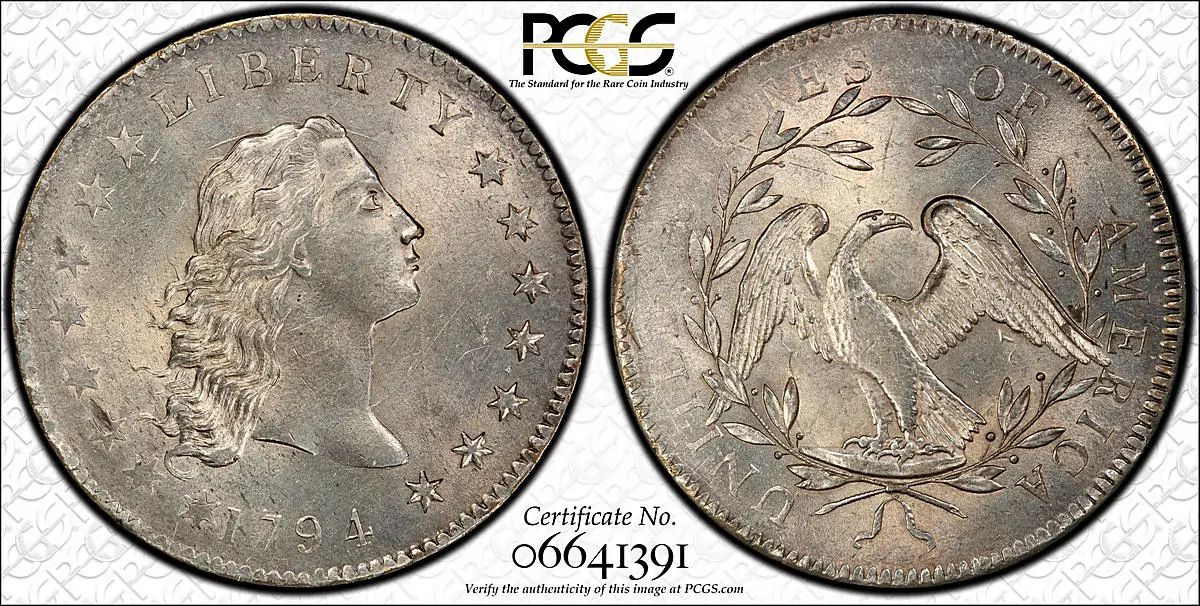
For high-value coins like the one pictured above: which sold for millions: the storage isn't just about chemistry; it's about security. For your average "filler" coins, high-quality plastic tubes are perfectly fine. Match the storage method to the value and the sensitivity of the metal. Copper is the most reactive, followed by silver, then gold. Treat your copper with the most care regarding humidity.
Looking Forward: The 2026 Emerging Liberty
As we look toward the future of the hobby, storage remains the most critical "boring" part of the job. With the release of the 1776-2026 Emerging Liberty Dime, we’re seeing a whole new generation of collectors entering the fray.

This dime represents the first major redesign of the circulating dime in eighty years. If you’re planning on grabbing these from the Mint or finding them in the wild, start them off on the right foot. Don’t throw them in a jar. Don’t put them in an old PVC flip you found in a desk drawer. Give these modern beauties the same respect you'd give a classic 1916 Quarter.
The Bottom Line
Coin collecting is a long game. We are essentially the temporary stewards of these historical artifacts. Whether you're listening to our coin collecting podcast for the latest news or browsing the tables at a local show, always keep storage in the back of your mind.
Avoid PVC like the plague, keep your hands off the surfaces, control your humidity, and match your storage to the coin's value. If you do those things, your collection will still be shining bright when it’s time to pass it on to the next generation.
Got a storage horror story? Or maybe a tip we missed? Let Matt and the team know: we might just feature it on the next episode of The Coin Show! Until then, keep your flips stiff and your silver bright.