
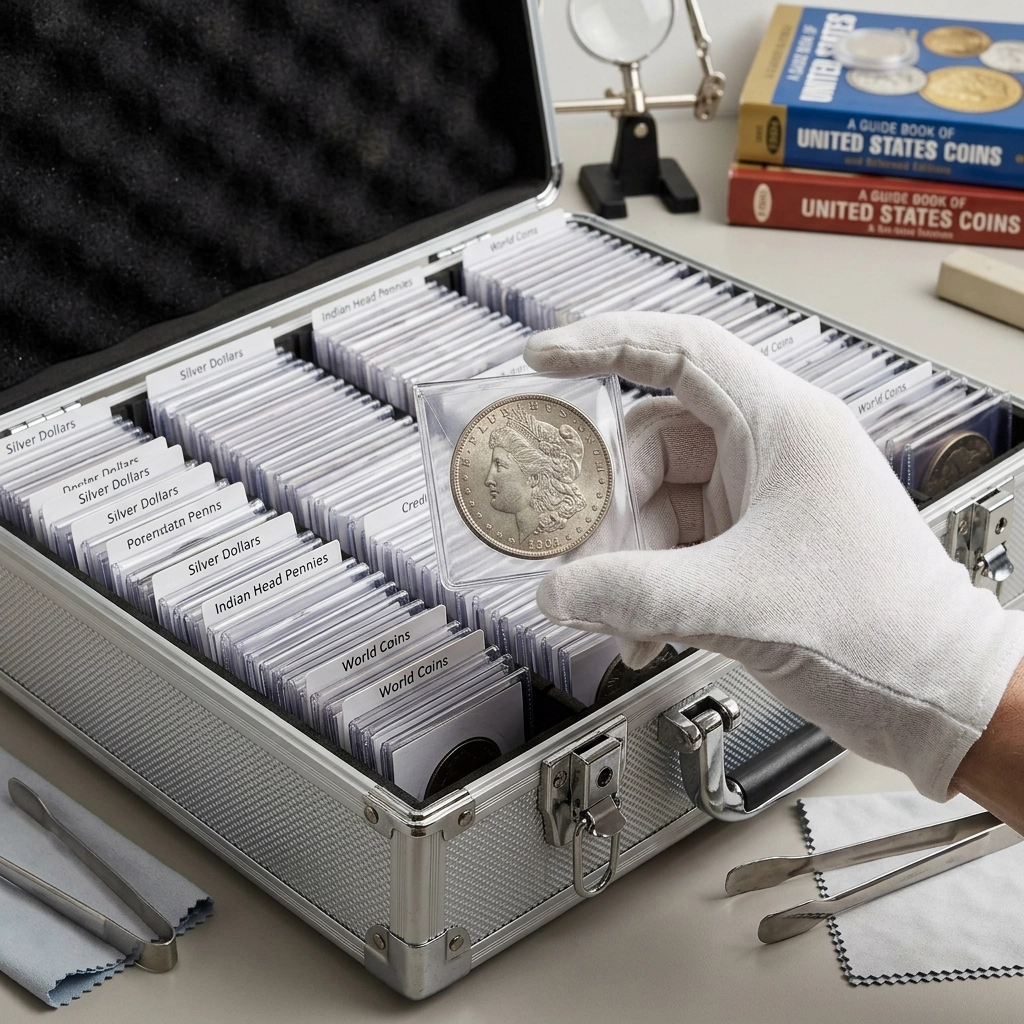
How to Store Coin Collections: The Simple Trick to Protect Your Coins Right Now
Hey there, fellow collectors. Matt Dinger here from The Coin Show. If you’re like me, you’ve spent a fair amount of time (and probably a decent chunk of change) hunting down that perfect addition to your set. Whether it’s a dusty find from a local shop or a high-grade beauty you snagged at a major auction, there is a specific kind of panic that sets in when you realize your storage setup might be slowly destroying your investment.
Welcome to "The Daily Mint." Today, we’re talking about the one thing every collector needs to master: how to store coin collections. I’m going to share a simple trick you can use right now to keep your coins safe, along with some hard truths about the plastic lurking in your desk drawer.
The Simple Trick: The Silica Gel Secret
Before we get into the heavy-duty safes and high-tech slabs, let’s talk about the cheapest, easiest thing you can do today.
Most people think the biggest threat to their coins is a thief or a fire. While those are scary, the most common "coin killer" is actually the air. Humidity is the silent enemy of numismatics. It triggers oxidation, causes copper coins to turn spotted or "woody," and can lead to ugly toning on silver.
The simple trick? Silica gel packs.
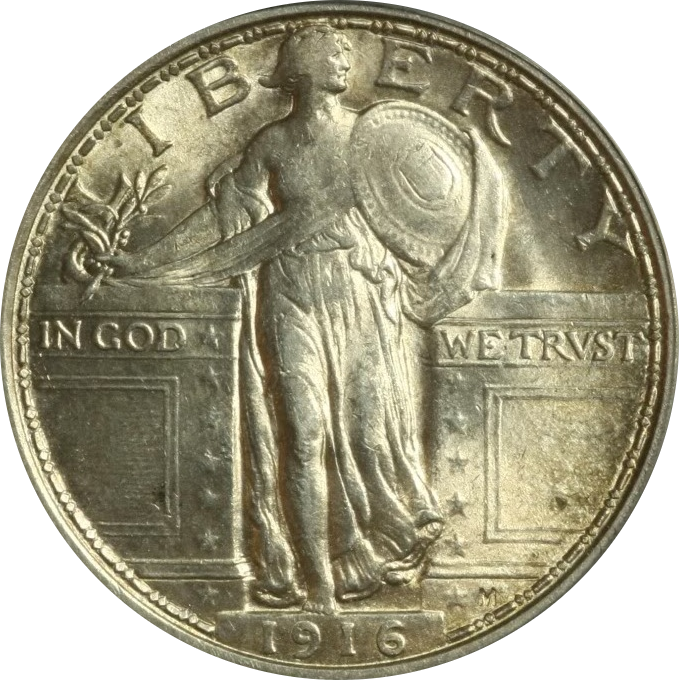
You know those little "Do Not Eat" packets that come in shoeboxes or electronics? They are worth their weight in gold for coin collectors. If you store your coins in a safe, a box, or even a drawer, toss a few silica gel packs in there. They act as a desiccant, pulling moisture out of the air before it can settle on your 1916 Standing Liberty Quarter. For a few dollars, you can buy larger, rechargeable desiccant canisters that change color when they’re full of moisture. You just pop them in the oven to dry them out, and they’re ready to go again. It’s the single most effective way to stabilize your storage environment.
The Enemy in the Plastic: Coin PVC Damage
If you’ve been around the hobby for more than a week, you’ve probably heard the term "PVC" whispered like a ghost story. PVC stands for polyvinyl chloride. In the early days of the hobby, many coin "flips" (those clear plastic pockets) were made with PVC to make them soft and pliable.
The problem? Over time, the chemicals used to soften the plastic (plasticizers) leak out. They create a sticky, green goo that coats the coin. This is coin PVC damage, and it’s a nightmare. If left long enough, that green slime will actually eat into the surface of the metal, permanently damaging the coin’s luster and grade.
If your coin holders are soft, oily, or smell like a new shower curtain, get your coins out of them immediately. Replace them with non-PVC Mylar flips. Mylar is stiff and a bit more brittle, but it’s chemically inert. It won't hurt your coins, even if they stay in there for decades.
Understanding Coin Storage for Collectors
When deciding how to store your collection, you need to balance two things: protection and accessibility. Here’s a breakdown of the most common methods used by the pros.
1. Cardboard 2×2 Flips
These are the staples of the hobby. They are cheap and allow you to write notes (date, mintmark, price paid) directly on the holder. Just make sure you use a flat-clinch stapler so the staples don't scratch other coins when you stack them.
2. Plastic Tubes
If you’re stacking silver eagles or common-date wheat cents, tubes are the way to go. They save space and protect the coins from physical contact. Just ensure they are made of archival-safe materials like polypropylene.
3. Hard Plastic Capsules
For your "stars": the coins you want to show off: Air-Tite capsules are fantastic. They provide a literal air-tight seal and are made of hard acrylic that won't yellow or scratch easily.
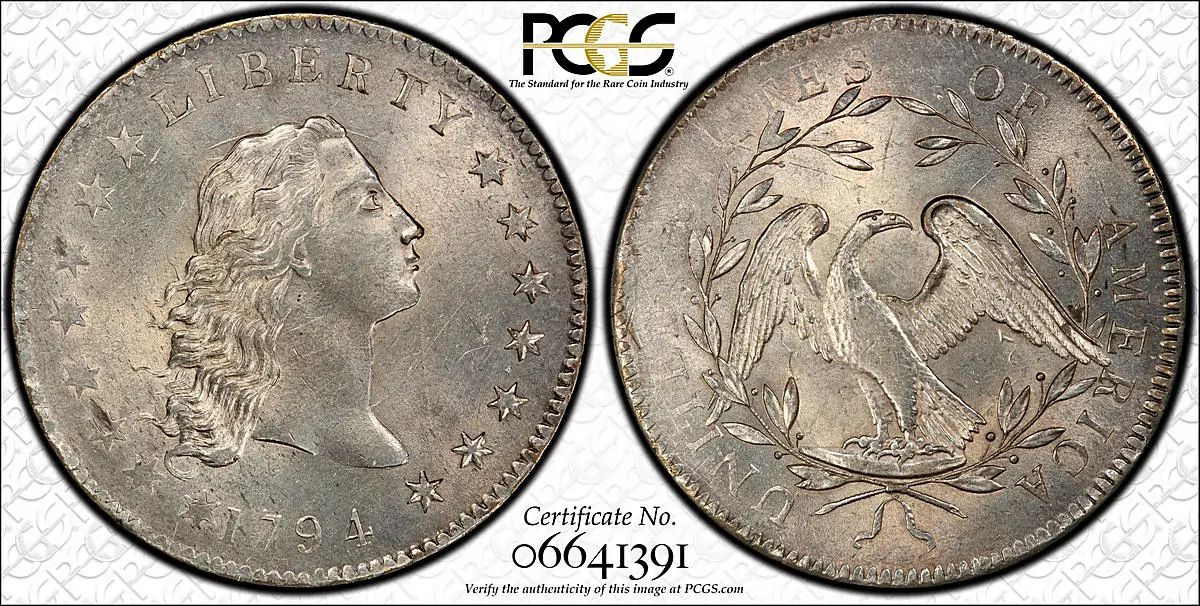
Look at the image above of the 1794 Flowing Hair Silver Dollar. A coin that sold for $4.5 million isn't just sitting in a cardboard flip. It’s protected by a professional grading service slab. Which brings us to our next point.
Slabs and ANA Grading Standards
If you have a coin that is particularly valuable, such as a high-grade 1916 Standing Liberty Quarter or a rare gold piece, you should consider professional grading. Companies like PCGS or NGC evaluate the coin based on ANA grading standards and seal it in a sonically welded plastic holder.
These "slabs" are the gold standard for storage. They protect the coin from physical damage, slow down environmental toning, and: most importantly: guarantee the grade and authenticity. This is also your first line of defense in counterfeit coin detection. If a professional grader has slabbed it, you can sleep soundly knowing your "rarity" isn't a clever fake from an overseas workshop.
Where Should You Keep Your Collection?
You’ve got your silica gel, you’ve ditched the PVC, and your best pieces are slabbed. Now, where do you put the box?
The "Never" List:
- The Attic: Too hot. Heat accelerates chemical reactions.
- The Basement: Too damp. Humidity will bypass even the best seals eventually.
- Near Vents: Constant temperature fluctuations are bad for metal.
The "Always" List:
- A Cool, Dry Closet: Interior closets are usually the most stable environments in a home.
- A Fireproof Safe: If you keep coins at home, get a safe that is bolted to the floor. Note: some fireproof safes actually release moisture to keep the interior cool during a fire. If you use one of these, you must use extra desiccant.
- Safety Deposit Box: For high-value items, the bank is still the safest place. It’s climate-controlled and highly secure.
Why This Matters: A Historical Lesson
We don't just protect coins because they are worth money; we protect them because they are pieces of history. Take a look at the upcoming 1776-2026 Emerging Liberty Dime.
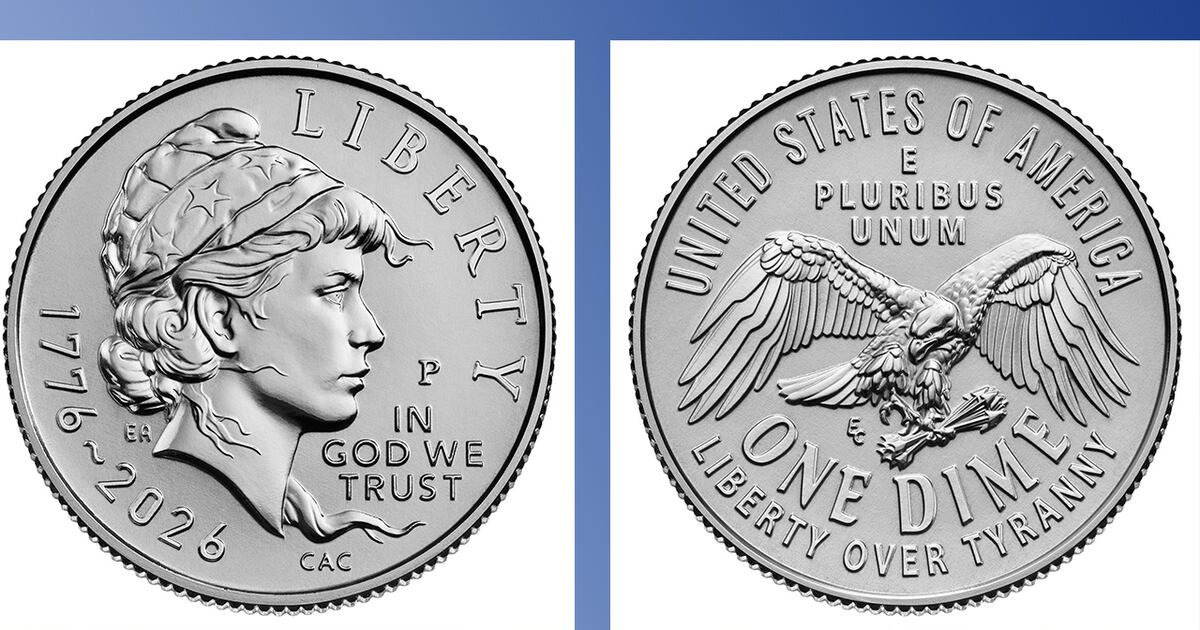
This design represents 250 years of American history. When you store a coin properly, you’re ensuring that 100 years from now, a future collector can look at that same dime and see exactly what we see today. We are just the temporary caretakers of these metallic artifacts.
Learning More: Podcasts and Shows
If you’re feeling overwhelmed, don't worry. Coin collecting is a marathon, not a sprint. One of the best ways to keep up with coin collecting tips is to immerse yourself in the community.
If you enjoy hearing about the latest finds and the technical side of the hobby, check out a coin collecting podcast or a numismatic podcast. On The Coin Show, we dive deep into these topics every week, talking to experts about everything from die varieties to the current market trends.
And if you really want to see the best storage solutions in person, you need to ask yourself: what is a coin show? A coin show is a gathering of dealers and collectors where you can buy supplies, see thousands of coins in person, and talk to people who have been doing this for fifty years. It’s the best place to find those archival-safe albums and heavy-duty storage boxes that you can’t always find at the local hobby shop.
Final Checklist for Your Collection
Let’s wrap this up with a quick action plan you can finish before your coffee gets cold:
- The Smell Test: Go to your coins. If they smell like plastic or chemicals, move them.
- The Silica Swap: Order some silica gel packs or canisters. Put them in your storage containers today.
- Audit Your Flips: If you see any green residue on your coins, it’s PVC. Research how to safely remove it (usually an acetone bath, but be careful!) and get them into Mylar.
- Check Your Values: If a coin in your collection is worth more than $200-$300, it might be time to stop using cardboard and start using hard capsules or professional grading.
Proper storage isn't just about preserving value: it's about peace of mind. You’ve worked hard for your collection. Don't let a little bit of humidity or a bad plastic flip take it away from you.
Keep hunting, keep learning, and keep those coins dry!
- Matt Dinger
Host of The Coin Show